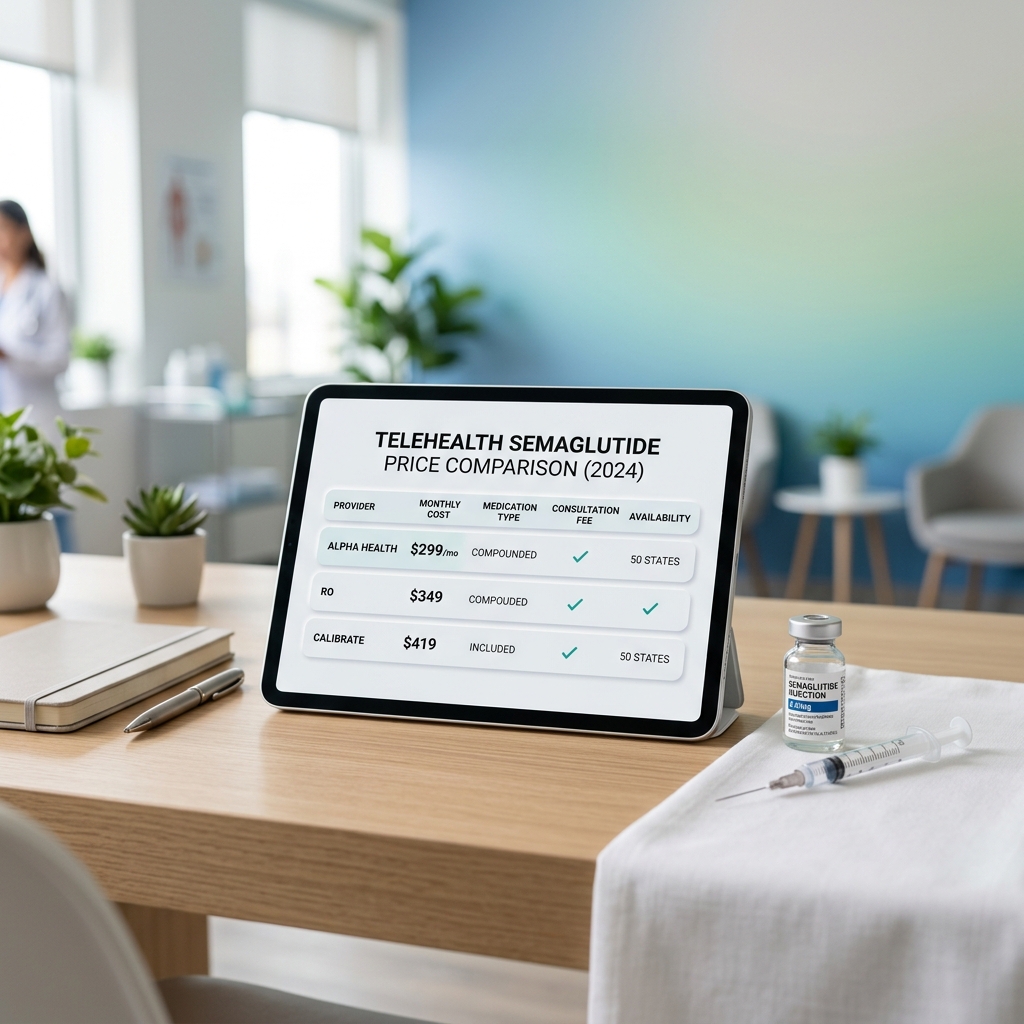
- The Price Range: Telehealth providers charge between $146/mo and $1,999/mo for semaglutide. Finding the cheapest option requires looking beyond advertised "teaser" rates to calculate the true all-inclusive monthly cost.
- Titration Price Hikes: Competitors like Henry Meds ($199–$349/mo) and PlushCare ($200–$350/mo) raise rates as you increase your dosage, which is medically required to achieve and maintain weight loss.
- Membership Traps: Providers like Ro ($223–$498/mo) advertise low medication prices but force patients into a mandatory $99/mo program membership, adding over $1,100 of annual overhead.
- Commitment Penalties: Hims offers compounded semaglutide at a competitive rate ($298/mo), but forces patients to pay 3, 6, or 12 months upfront, creating a massive upfront financial barrier ($3,576).
- Clear Winner: Losing Weight RX provides U.S. licensed compounded semaglutide at a flat-rate $146/mo, all-inclusive (evaluation, medication, and shipping) with zero price hikes as your dose escalates.
The Rise of Semaglutide and the Telehealth Pricing Maze
The landscape of weight loss medicine was permanently altered by the clinical approval of semaglutide, a glucagon-like peptide-1 (GLP-1) receptor agonist that acts on the brain and stomach to mimic natural satiety. In clinical trials, semaglutide helped participants achieve an average of 15% to 17% reduction in total body weight when paired with lifestyle modifications. This level of efficacy made semaglutide the gold standard in modern obesity care, outperforming decades of previous weight-loss medications.
However, for the vast majority of patients, access to brand-name semaglutide (sold as Wegovy® for weight loss and Ozempic® for type 2 diabetes by Novo Nordisk) is blocked by a single, massive hurdle: cost. Wegovy carries a U.S. list price of approximately $1,349 per month. For patients whose commercial insurance plans exclude weight loss coverage—which is estimated to be over 75% of employer-sponsored plans—the drug is financially out of reach. Furthermore, persistent global supply-chain shortages have made finding brand-name auto-injectors at local pharmacies an exhausting chore.
In response, the market has seen a rapid expansion of telehealth companies offering compounded semaglutide. Compounded semaglutide uses the identical active pharmaceutical ingredient as Wegovy, but is prepared on an individual basis by state-licensed 503A compounding pharmacies. This pathway reduces the monthly cost of treatment by up to 89%, allowing patients to pay out-of-pocket without relying on insurance approval.
But the explosion of online providers has created a new challenge. The telehealth space has become a maze of confusing subscription fees, hidden doctor-visit charges, multi-month prepay commitments, and price increases that kick in as soon as your dose escalates. This detailed comparison breaks down the top 8 telehealth platforms alongside Losing Weight RX to expose the true cost of semaglutide online in 2026.
Decoding Telehealth Billing: Traps and Hidden Fees
Before examining individual companies, it is vital to understand the business models used by telehealth platforms. Many companies design their landing pages to highlight a low starting rate, leaving the true monthly cost buried deep within their terms of service. When evaluating the cost of semaglutide online, patients must look beyond the initial landing page hook and calculate the true all-inclusive monthly expense over a full 12-month period.
1. The "Dose Escalation" Trap
Clinical GLP-1 therapy requires a strict schedule known as titration. Because semaglutide affects the digestive tract, patients start on an initial dose of 0.25 mg per week for the first four weeks. This low dose allows the body to adapt and minimizes side effects like nausea or acid reflux. Every four weeks, the dose is gradually escalated (to 0.5 mg, 1.0 mg, 1.7 mg, and finally the maintenance dose of 2.4 mg per week) until the patient reaches their target clinical maintenance level.
Many telehealth platforms exploit this medical requirement by charging a low introductory price (e.g., $199/mo) that only covers the initiation doses (0.25 mg and 0.5 mg). Once you progress to the therapeutic maintenance doses (1.0 mg and above), the company increases the price. Some platforms charge up to $150 more per month for maintenance doses, effectively penalizing you for following the medically prescribed treatment plan. Since metabolic weight loss requires remaining on the maintenance dose for several months or years, this represents a massive, predictable price hike for every successful patient.
2. The "Membership Fee" Trap
Another common tactic is splitting the program cost into two separate bills: the membership fee (or clinical consultation fee) and the medication fee. A company might advertise compounded semaglutide for a seemingly low price of $199 or $250 per month. However, in the fine print, they require a mandatory monthly subscription to their "clinical weight loss platform" or "coaching program" that costs an additional $49 to $99 per month. When you add the two charges together, the actual out-of-pocket cost is far higher than the advertised price. Over a year, a $99/mo membership alone adds $1,188 of overhead without purchasing a single milligram of medication.
3. The Upfront Multi-Month Commitment
To secure the lowest advertised price on some major telehealth platforms, patients are forced to pay for multiple months of treatment upfront. While this model secures a lower average monthly price, it requires an upfront cash payment of $800 to over $3,500. This presents a major financial barrier for patients who cannot afford thousands of dollars upfront, even if it saves them money over the course of a year. Additionally, if you experience severe side effects and must discontinue the medication in the first month, these upfront fees are rarely refundable, leaving you out of pocket with unused medication.
4. The Insurance Prior Authorization Maze
For platforms that prescribe brand-name GLP-1s, the primary administrative mechanism is the Prior Authorization (PA) process. Insurance companies use PAs to restrict coverage to patients meeting narrow clinical thresholds—typically a BMI ≥ 30, or ≥ 27 with at least one weight-related comorbidity (such as hypertension, type 2 diabetes, or obstructive sleep apnea), combined with documented failure of previous lifestyle interventions. Telehealth companies frequently charge extra "insurance coordination" fees to submit these forms. If the PA is denied, the patient is left with a membership fee and no medication, or is forced to pay the full cash price at the pharmacy counter.
The Science: Why Compounded Semaglutide is More Affordable
Patients frequently ask how compounding pharmacies can legally provide the exact same active molecule at a fraction of the brand-name price. The answer lies in the economics of the pharmaceutical industry. The $1,349 monthly list price of Wegovy® does not reflect the cost of manufacturing the semaglutide molecule itself; rather, it is designed to recoup Novo Nordisk's massive research and development (R&D) costs, fund global marketing campaigns, cover the cost of their proprietary single-use auto-injector pens, and satisfy corporate profit targets.
Traditional compounding pharmacies, operating under Section 503A of the Federal Food, Drug, and Cosmetic Act, do not have these overhead costs. They purchase pharmaceutical-grade semaglutide active pharmaceutical ingredient (API) from chemical manufacturers, compound it under sterile conditions into multi-dose vials, and distribute it directly to patients. The patient administers the medication using standard, inexpensive insulin syringes. By stripping away the brand-name markup, the patented auto-injector pen, and corporate advertising budgets, compounding pharmacies can sell the identical medication at its true cost of production and clinical oversight.
Clinical Validation: The STEP Clinical Trials
The clinical efficacy of semaglutide is backed by the Semaglutide Treatment Effect in People with Obesity (STEP) clinical trial program. In the landmark STEP 1 trial, published in the New England Journal of Medicine, 1,961 adults with a BMI of 30 or greater (or 27 or greater with comorbidities) were randomized to receive once-weekly subcutaneous semaglutide 2.4 mg or a placebo, alongside a lifestyle intervention. After 68 weeks, participants receiving semaglutide achieved an average weight loss of 14.9% of their baseline body weight, compared to just 2.4% in the placebo group. Over 86% of the semaglutide group achieved weight loss of 5% or more, a standard clinical threshold for improving metabolic health. Subsequent trials (STEP 2 through STEP 8) confirmed these findings across diverse patient populations, highlighting the critical role of maintaining therapeutic doses (1.7 mg and 2.4 mg) to sustain weight loss and prevent weight regain.
Get Compounded Semaglutide at a Transparent Flat Rate — $146/mo
No membership fees, no multi-month prepay traps, and no dose escalation charges. Pay a single flat rate of $146/mo for U.S. licensed pharmacy compounding at all dosage levels.
Start Your AssessmentDeep Dive: Detailed Cost Profiles of the Top 8 Competitors
To help you compare the market objectively, we have analyzed the billing structures, dosage policies, and onboarding programs of the top eight telehealth providers offering semaglutide online in 2026.
1. Hims & Hers ($298–$348/mo total)
Hims & Hers entered the compounded GLP-1 market with aggressive marketing, utilizing their established telemedicine infrastructure. They offer compounded semaglutide sourced from partner compounding pharmacies, providing a streamlined online intake process and clinical oversight.
The Catch: While Hims advertises a competitive monthly rate, that rate is only available if you prepay for a full year upfront. If you choose the annual plan, you must pay $3,576 at checkout, which averages out to $298 per month. If you prefer a shorter 3-month or 6-month billing cycle, the price rises to $348 per month, which still requires a multi-month commitment. Hims does not offer a true month-to-month plan without an upfront multi-month charge, making it difficult for patients to test the medication's tolerance before committing thousands of dollars. Furthermore, canceling mid-cycle does not result in a pro-rated refund for the unused months.
2. Ro ($223–$498/mo total)
Ro (formerly Roman) operates a high-profile clinical weight loss program. They initially focused exclusively on brand-name Wegovy® and Ozempic®, offering insurance concierge services to help patients secure coverage. In response to shortages and high out-of-pocket costs, they introduced compounded semaglutide.
The Catch: Ro is one of the clearest examples of the membership fee trap. To access medication through Ro, you must join the Ro Body Program, which costs $99 per month. This fee is mandatory and covers only the doctor's consultations and coaching—it does not include the medication. Compounded semaglutide is billed as a separate charge of $299 per month. This brings your true monthly total to $398. While they occasionally offer "introductory" promotions (such as $223 for the first month), the long-term maintenance cost remains very high due to the dual-billing structure. If you cancel the membership, your prescription access is terminated immediately.
3. Henry Meds ($199–$349/mo)
Henry Meds was one of the earliest and most recognizable brands in the compounded GLP-1 space. They established a large customer base by offering a clear subscription model that bypassed insurance requirements entirely and shipped medication directly to patients' homes.
The Catch: Henry Meds is a primary user of the dose escalation pricing model. They advertise a flat rate of $199 per month, which is highly appealing to beginners. However, this rate only covers active doses up to 1.0 mg per week. If your doctor determines that you need the standard therapeutic maintenance dose of 2.0 mg or 2.5 mg per week to maintain weight loss, Henry Meds charges an additional $100 per month, raising the total monthly cost to $299. If you choose their sublingual (oral) semaglutide option, the cost can rise even further, reaching up to $349 per month. Additionally, patients are required to draw their own doses from a vial using insulin syringes, which requires careful unit-to-milligram conversion calculations.
4. Calibrate ($1,099–$1,999/mo without insurance)
Calibrate takes a comprehensive, coaching-intensive approach to metabolic health. They do not offer compounded GLP-1 medications; instead, their program is built entirely around prescribing brand-name Wegovy®, Ozempic®, Mounjaro®, or Zepbound® and submitting prior authorizations to insurance companies.
The Catch: Calibrate requires a mandatory annual membership fee of $1,649, paid upfront. This membership covers medical evaluations, lab reviews, and bi-weekly coaching sessions, but does not include the cost of the medication. If your insurance plan denies coverage for brand-name GLP-1s, you must pay the full retail pharmacy price of the drug out-of-pocket (ranging from $1,099 to $1,999/mo). If you pay for the program upfront and your insurance subsequently denies the medication, Calibrate's refund policies are highly restrictive, making it an extremely high-risk option for uninsured patients. The platform has faced significant criticism from consumer protection agencies due to billing practices and refund delays.
5. Noom Med ($199–$279/mo)
Noom Med is the clinical extension of Noom's widely used behavioral coaching app. It pairs their cognitive behavioral therapy curriculum with medical evaluations and GLP-1 prescriptions, offering both brand-name and compounded options through pharmacy partners.
The Catch: Similar to Ro, Noom Med splits its pricing. You must pay a monthly Noom Med clinical membership fee of $49, which covers the doctor visits and app access. The cost of compounded semaglutide is billed on top of this membership, starting at $150 to $230 per month depending on the pharmacy partner. This brings the true out-of-pocket total to $199–$279 per month. If you decide to cancel the behavioral coaching portion, you lose access to the medical providers and the prescription service. Daily food logging and behavioral curriculum completion are highly encouraged, which some patients find overly demanding.
6. Found ($498–$998/mo)
Found offers a personalized weight-loss program that prescribes various medications, including oral weight-loss options and GLP-1s, based on a patient's genetic and lifestyle profile. They emphasize lifestyle change alongside pharmaceutical support.
The Catch: Found's GLP-1 program is one of the most expensive online options. Because they bundle coaching, medical access, and medication into a single high-tier plan, their GLP-1 pricing ranges from $498 to $998 per month, depending on whether you receive compounded semaglutide or brand-name Wegovy®. While they offer lower pricing for non-GLP-1 oral medication regimens, their semaglutide paths are financially prohibitive for most self-paying patients who do not have comprehensive insurance coverage.
7. Sesame Care ($208–$448/mo)
Sesame Care operates as a direct-to-consumer medical marketplace, connecting patients directly with independent doctor consultations. They offer a dedicated GLP-1 weight loss program designed to match patients with local or mail-order pharmacies.
The Catch: Sesame's model is highly fragmented. To join their GLP-1 program, you must pay a monthly program fee (or sign up for a Sesame Plus membership for $10.99/mo or $84/yr). The initial program subscription covers the doctor's visit, but the medication is paid separately at the pharmacy counter. Sesame partners with compounding pharmacies to offer semaglutide starting at $199/mo, but because they do not control the pharmacy billing directly, prices vary by state, and dose escalation charges frequently increase the total monthly cost to over $440. Finding a stable price point requires constant communication between the marketplace provider and the pharmacy.
8. PlushCare ($200–$350/mo)
PlushCare is a prominent primary care telemedicine platform that offers a specialized weight loss program. Like Calibrate, they focus primarily on prescribing brand-name GLP-1s and coordinating prior authorizations with commercial insurance.
The Catch: PlushCare requires a monthly membership fee of $16.99. On top of this membership fee, you must pay for each doctor's appointment, which costs $129 out-of-pocket (or your insurance copay). The cost of the medication is entirely separate. If you choose to receive compounded semaglutide through one of their pharmacy partners, the pharmacy charges you directly. Depending on your state, the pharmacy, and your dosage level, the combined cost of the membership, doctor visits, and medication ranges from $200 to $350 per month, assuming you do not pay full retail for brand-name Wegovy®.
The 2026 Semaglutide Cost Comparison Table
To summarize the complex billing structures of these providers, the table below outlines the true, all-inclusive monthly costs, exposing the hidden fees, dose escalation charges, and commitment requirements of each platform.
| Provider | Advertised Price | Mandatory Membership Fee | Dose Escalation Fees | Prepay Requirement | True Monthly Total |
|---|---|---|---|---|---|
| Losing Weight RX | $146 / mo | None ($0) | No (Flat rate) | No (Month-to-month) | $146 / mo (Flat rate) |
| Henry Meds | $199 / mo | None | Yes (+$100/mo for maintenance) | No | $199 – $349 / mo |
| Noom Med | $150 / mo | $49 / mo | Yes (Varies by pharmacy) | No | $199 – $279 / mo |
| PlushCare | Varies | $16.99 / mo + $129/visit | Yes (Varies by pharmacy) | No | $200 – $350 / mo |
| Sesame Care | $199 / mo | $10.99/mo + visit fees | Yes | No | $208 – $448 / mo |
| Ro | $299 / mo | $99 / mo | No | No | $223 – $498 / mo |
| Hims & Hers | $298 / mo | None | No | Yes (3, 6, or 12 months upfront) | $298 – $348 / mo |
| Found | Varies | Included in bundle | Yes | No | $498 – $998 / mo |
| Calibrate | $1,649 / yr | $1,649 / yr upfront | N/A (Brand-name only) | Yes ($1,649 upfront) | $1,099 – $1,999 / mo (without insurance) |
Losing Weight RX: True Cost Transparency
Losing Weight RX was founded specifically to challenge the opaque pricing practices of the telehealth industry. We believe that clinical weight loss support should be simple, safe, and affordable, without requiring patients to solve complex mathematical equations to determine what they will pay each month.
Our pricing model is straightforward: **$146 per month, flat-rate, all-inclusive.** Here is exactly what that covers:
- The Medication: Compounded semaglutide containing the identical active molecule as Wegovy® and Ozempic®.
- No Dose Escalation Charges: You pay the exact same $146/mo fee whether you are on the starting dose of 0.25 mg or the clinical maintenance dose of 2.4 mg. We do not charge you more for succeeding in your titration plan.
- No Membership Fees: We do not charge software subscriptions, platform fees, or app fees. You pay only for your medical care and medication.
- Licensed Medical Consultation: A U.S. licensed healthcare provider reviews your comprehensive intake form, evaluates your health history, and writes your prescription.
- Free Shipped Delivery: Your medication is prepared by a state-licensed 503A pharmacy and shipped directly to your door in temperature-controlled, cold-chain packaging via expedited delivery, free of charge.
- Cancel Anytime: We do not lock you into annual contracts or force you to pay for 3 to 12 months upfront. You pay month-to-month and can pause or cancel your program at any time.
By offering a flat rate of $146/mo, Losing Weight RX is the most affordable clinical semaglutide provider in the United States, providing a savings of over 50% compared to typical telehealth competitors and an 89% savings compared to retail brand-name GLP-1 list prices.
The Safety Checklist: How to Verify Online Semaglutide Safely
While finding the cheapest semaglutide online is important, clinical safety must always remain your primary priority. Injecting a medication into your body requires sterile preparation, verified ingredients, and proper medical oversight. When choosing an online provider, use the checklist below to verify that they follow rigorous clinical safety standards:
- Confirm 503A Pharmacy Licensing: Legitimate compounded semaglutide must be prepared by a state-licensed compounding pharmacy operating under Section 503A of the FD&C Act. Avoid any website that does not disclose the name and licensing details of their pharmacy partners.
- Demand USP <797> Sterility Compliance: Injections must be prepared in ISO Class 5 sterile environments that comply with United States Pharmacopeia Chapter 797 standards. This prevents contamination and safeguards against bacterial infection.
- Verify the Prescription Requirement: Under federal law, semaglutide is a prescription-only medication. Any online seller that offers to ship semaglutide without requiring a medical evaluation or a valid prescription is operating illegally. These sources, often labeled as "research peptides," are unregulated, chemical-grade substances that are not approved for human use and carry severe safety risks.
- Ask for a Certificate of Analysis (CoA): Reputable pharmacies test their compounded batches for sterility, purity, and potency through independent, third-party laboratories. You should be able to request a CoA showing that your batch contains the correct concentration (within ±10% of the labeled dose).
- Avoid overseas pharmacies: Medications imported from unregulated foreign pharmacies bypass FDA import safety rules. Keep your treatment within the U.S. legal supply chain.
At Losing Weight RX, we manage the safety verification on your behalf. We partner exclusively with state-licensed U.S. 503A pharmacies that meet all USP sterile standards. Every patient undergoes an evaluation by a U.S. licensed medical prescriber, ensuring that your weight loss program is clinically appropriate and safe for your metabolic profile.
Frequently Asked Questions
Many telehealth providers use a tiered pricing structure, commonly referred to as the "dose escalation trap." When patients begin GLP-1 therapy, they start on a low initiation dose (typically 0.25 mg per week) to build tolerance. As the patient titrates up to clinical maintenance doses (such as 1.7 mg or 2.4 mg per week), the pharmacy cost increases. Competitors like Henry Meds and PlushCare pass this cost to the patient, raising monthly prices by $100 to $150. Transparent providers, like Losing Weight RX, offer flat-rate pricing where you pay the same rate ($146/mo) regardless of your dosage level.
A membership trap occurs when a telehealth company advertises a low price for compounded semaglutide, but hides the fact that you must pay a mandatory monthly or yearly membership fee to access their medical providers. For example, Ro advertises a medication cost of $299/mo, but requires a $99/mo Ro Body Program membership, bringing the actual cost to $398/mo. Similarly, Calibrate requires a $1,649 upfront annual membership before medication costs are even considered. These hidden fees significantly increase the true cost of care.
Compounded semaglutide contains the identical active pharmaceutical ingredient (API)—the semaglutide peptide—as brand-name Wegovy and Ozempic. Chemically, the active molecule is indistinguishable, binds to the same GLP-1 receptors, and produces identical metabolic results. The differences lie in the inactive ingredients (excipients), the delivery method (vials and syringes instead of proprietary auto-injector pens), and the regulatory pathway. Brand-name products are mass-manufactured by Novo Nordisk, whereas compounded semaglutide is customized by state-licensed 503A pharmacies.
To verify safety, ensure the provider requires a medical consultation and a valid prescription. Confirm that they work exclusively with state-licensed U.S. pharmacies operating under Section 503A, and ask if their pharmacy partners comply with USP <797> sterile compounding standards. Avoid any company that refuses to identify their compounding pharmacies or does not conduct identity and medical health evaluations before prescribing.
No. Under federal and state laws, semaglutide is a prescription-only drug. Any website offering to sell semaglutide without a prescription is operating illegally. These products are often sold online as "research chemicals" or "research peptides" and are not subject to sterile pharmaceutical standards. Injecting unregulated research materials poses severe health risks, including contamination, incorrect dosing, and exposure to toxic impurities. Always work with a licensed medical provider.
Losing Weight RX costs a flat $146 per month, all-inclusive. In comparison, Henry Meds ranges from $199 to $349 per month as doses increase. Hims costs $298 to $348 per month and requires multi-month commitments. Ro costs $398 per month when combining their platform membership and medication fee. PlushCare, Sesame, and Noom Med all exceed $200 per month due to separate membership and consultation charges, making Losing Weight RX the most affordable and transparent option on the market.
Start Compounded Semaglutide Today for a Flat $146/mo
Complete a 5-minute online medical assessment, get evaluated by a licensed U.S. provider, and receive sterile compounded semaglutide shipped directly to your door. Flat-rate billing at all doses.
Get Started TodayClinical References & Sources
- Wilding, J. P. H., Bateman, A. H., et al. (2021). Once-weekly semaglutide in adults with overweight or obesity. New England Journal of Medicine, 384(11), 989-1002. ClinicalTrials.gov (NCT03548935)
- U.S. Food and Drug Administration. (2024). Human Drug Compounding Under Section 503A of the FD&C Act. FDA.gov Guidance
- U.S. Food and Drug Administration. (2026). FDA Drug Shortages Database. FDA Shortages Log