- Tirzepatide is the fastest: Activating both GIP and GLP-1 receptors, Tirzepatide leads to slightly faster initial weight reduction and the greatest total weight loss (up to 22.5% in trials).
- Semaglutide starts rapidly: While total reduction is slightly lower (14.9% average in STEP 1), Semaglutide suppresses hunger and eliminates "food noise" within 24 to 48 hours of the first dose.
- Visible results timeline: Scale changes can start in week 1, but significant visible weight loss and body composition shifts typically require 8 to 12 weeks of treatment.
- Titration is non-negotiable: Gradual escalation (starting at 0.25 mg for Semaglutide) is medically necessary to build tolerance. Attempting to skip steps to lose weight "faster" causes severe nausea and vomiting, leading to treatment failure.
- Compounded affordability: Access top-tier GLP-1 medications through Losing Weight RX's flat-rate pricing: compounded semaglutide is $79/mo and compounded Tirzepatide is $129/mo.
The Modern Quest for Rapid Weight Loss
When starting a medical weight loss journey, one of the most common questions is: "What is the fastest weight loss medication, and how fast will I see results?" In 2026, the landscape of weight management is dominated by highly effective GLP-1 (glucagon-like peptide-1) receptor agonists and dual GIP/GLP-1 receptor agonists. These modern peptides have completely transformed the treatment of chronic obesity, treating it as a complex metabolic disease rather than a simple failure of willpower. Historically, weight loss medications relied on central nervous system stimulants like phentermine, which carried significant cardiovascular risks, sleep disruption, and high rates of rebound weight gain once stopped. The shift toward incretin-based therapies—which mimic hormones naturally produced in the gut—represents a paradigm shift in both safety and speed.
However, understanding the physical speed of weight loss must be balanced with clinical safety, patient tolerability, and the biological reality of how these peptides interact with the human body. The rate at which you lose weight on a GLP-1 or GIP/GLP-1 dual receptor agonist depends on several factors, including the dosage, the rate of titration, starting body mass index (BMI), genetics, and compliance with dietary and lifestyle modifications. Simply seeking the absolute fastest drop in scale weight without regard for the composition of that weight loss (fat vs. muscle) or the physical tolerability of the drug can lead to severe health consequences, including gallbladder disease, muscle wasting (sarcopenia), and metabolic slowdown.
A successful weight reduction program is not just about shedding pounds as quickly as possible. Rather, it is about steady, sustainable fat loss that preserves lean muscle tissue and prevents severe gastrointestinal side effects. In this comprehensive clinical guide, we compare the weight loss timelines, mechanisms of action, and escalation schedules for the two leading medications in 2026: Tirzepatide and Semaglutide. We will also detail why standard titration is critical to long-term success, how metabolic adaptation governs your speed of weight loss, and how you can access these treatments affordably and safely.
Tirzepatide: The Dual-Receptor Speed and Efficacy Champion
From a clinical standpoint, the fastest weight loss medication currently available is Tirzepatide (commercially known as Zepbound® and Mounjaro®). Tirzepatide's superior speed and overall effectiveness are due to its unique chemical design. Unlike older, single-receptor agonists, Tirzepatide is a dual-acting agonist of both the GIP (glucose-dependent insulinotropic polypeptide) and GLP-1 receptors.
The Twincretin Advantage
By mimicking both GIP and GLP-1 hormones, Tirzepatide acts on two pathways in the body simultaneously. GIP enhances insulin secretion in response to glucose, modulates fat accumulation in adipose tissue, and acts on receptors in the brain's satiety centers. When combined with the appetite-suppressing, gastric-slowing properties of GLP-1, the two hormones work synergistically. Clinical data suggests that the GIP component helps buffer the brain against the nausea typically caused by GLP-1 activation, allowing patients to tolerate higher doses and achieve faster satiety.
Clinical Trial Evidence: The SURMOUNT-1 Trial
The landmark SURMOUNT-1 clinical trial, published in the New England Journal of Medicine, investigated the efficacy of Tirzepatide in adults with obesity or overweight. The results were unprecedented:
- Average Weight Loss: At the highest dose of 15 mg, participants lost an average of 22.5% of their total body weight (about 52 pounds) over 72 weeks.
- Rate of Initial Loss: Weight reduction was observed almost immediately. Significant differences on the scale were recorded by the first monthly assessment (week 4), with patients on the 15 mg titration schedule experiencing a rapid, linear drop in fat mass.
- Sustained Results: Over 96% of participants on the highest dose achieved at least a 5% reduction in body weight, showing a highly reliable rate of response across the patient cohort.
Because Tirzepatide targets dual pathways, it drives a higher metabolic rate, reduces cravings more intensely, and facilitates a slightly faster initial weight loss trajectory than single-receptor alternatives. It is the premier option for patients seeking maximum total weight loss and rapid biological response.
Semaglutide: Rapid and Reliable Appetite Control
While Tirzepatide holds the record for maximum total weight loss, Semaglutide (sold under the brand names Wegovy® and Ozempic®) remains a highly effective, rapid, and incredibly popular weight loss medication. As a selective GLP-1 receptor agonist, Semaglutide mimics the GLP-1 hormone to curb hunger, slow stomach emptying, and improve insulin sensitivity.
How Fast Does Semaglutide Work?
When patients ask, "how fast does semaglutide work," it is important to distinguish between metabolic onset and visible scale changes:
- Immediate Appetite Suppression (24–48 Hours): Semaglutide begins working in your system almost immediately after the subcutaneous injection. Most patients report a significant reduction in appetite, cravings, and the constant mental chatter about food (often called "food noise") within 24 to 48 hours of their very first 0.25 mg dose.
- Early Metabolic Adjustments (Weeks 1–4): During the first month on the initiation dose of 0.25 mg, your body is adjusting to the peptide. While some early weight reduction occurs—frequently driven by reduced water retention and lower caloric intake—this stage is focused on cellular acclimation rather than major fat loss.
- Visible Fat Loss (Weeks 8–12): Significant, visible changes in body composition and a noticeable reduction in clothing size typically become apparent between weeks 8 and 12. This timeline corresponds with the transition to therapeutic doses (1.0 mg and above), where the speed of weight loss on GLP-1 therapy stabilizes to a healthy, consistent rate.
Clinical Trial Evidence: The STEP 1 Trial
The clinical efficacy of Semaglutide was established during the STEP 1 clinical trial. In this study, adults with overweight or obesity took a 2.4 mg weekly dose alongside lifestyle interventions. Over the course of 68 weeks, participants achieved an average weight loss of 14.9% of their body weight. The trial demonstrated that Semaglutide is a highly reliable pathway to sustained fat loss, even if its ultimate ceiling is slightly lower than Tirzepatide's dual-receptor profile.
Get Started with Semaglutide for $79/mo or Tirzepatide for $129/mo
No insurance required. Enjoy flat-rate pricing across all dosage levels, free expedited shipping, and U.S. licensed provider evaluations. Fast-track your weight loss goals safely.
Start Your AssessmentThe Essential Dosing Roadmap: Standard Titration Schedules
Regardless of whether you choose Tirzepatide or Semaglutide, you cannot start at the maximum dose. The term titration schedule refers to the practice of starting a patient on a very low, sub-therapeutic dose of a medication and gradually increasing the dose over several weeks or months. This is a non-negotiable medical requirement for all GLP-1 receptor agonist therapies. But why is this the case? The biological explanation lies in how these peptides interact with receptors in the digestive tract and the central nervous system.
When you first inject a GLP-1 receptor agonist, it binds to receptors in the pancreas, stomach, intestines, and the area postrema—a region in the brainstem that controls nausea and vomiting. If a full maintenance dose were introduced to a patient who has never taken the drug, the sudden activation of these receptors would shut down gastric motility, stimulate the vomiting center of the brain, and cause severe systemic shock to the digestive system. By starting with a sub-therapeutic dose (such as 0.25 mg of Semaglutide or 2.5 mg of Tirzepatide), you allow these receptors to gradually desensitize. Over the course of four weeks, the body adjusts to the slow stomach emptying, the pancreas adapts its insulin and glucagon secretion patterns, and the brain adapts to the steady-state satiety signals. This cellular adaptation is what allows you to eventually tolerate therapeutic doses that would have made you severely ill on day one.
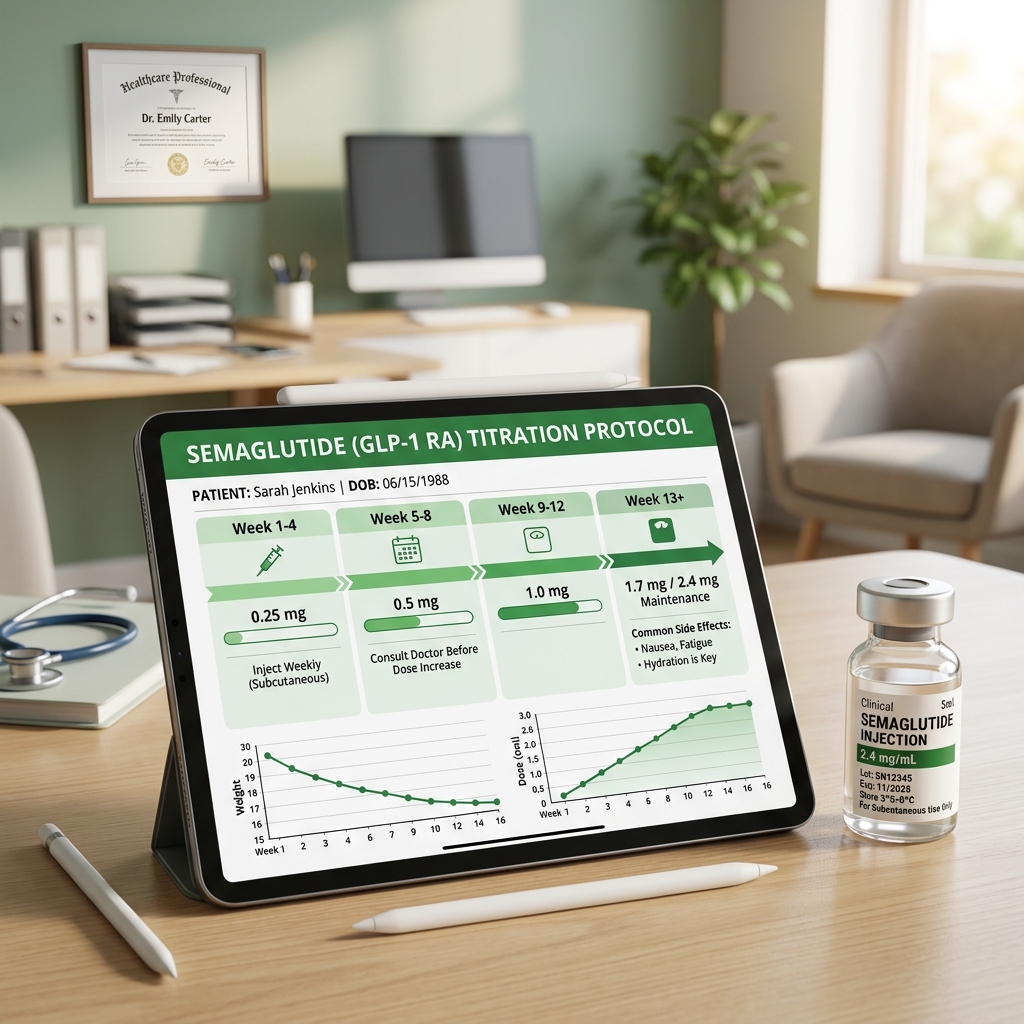
The Standard Semaglutide Titration Schedule
For Semaglutide, the escalation protocol is structured in 4-week blocks to give the gastrointestinal tract and brain satiety centers time to build tolerance to the hormone's effects:
Similarly, Tirzepatide titration starts at 2.5 mg weekly for the first 4 weeks, then increases in 2.5 mg increments every 4 weeks (to 5.0 mg, 7.5 mg, 10.0 mg, 12.5 mg, and finally 15.0 mg) as tolerated. Titration is not an arbitrary rule; it is a clinical safeguard designed to match your body's adaptation rate.
Slower is Faster: The Science of Gastrointestinal Adaptation
The modern obsession with rapid results leads some patients to ask: "Can I skip titration steps to lose weight faster?" The absolute medical consensus is no. Trying to bypass the titration schedule is a recipe for physical distress and treatment failure.
What Happens When You Skip Titration Steps?
Skipping doses or escalating too quickly overrides your body's safety mechanisms. The sudden flood of GLP-1 signals causes acute delay in gastric emptying. This leads to a backup of food in the stomach, resulting in severe gastrointestinal side effects:
- Intense Nausea and Projectile Vomiting: The stomach is temporarily unable to move food forward, causing painful reflux and vomiting.
- Severe Abdominal Cramps and Bloating: Intestinal motility slows down too rapidly, trapping gas and digestive waste.
- Dehydration and Electrolyte Depletion: Severe vomiting and diarrhea can quickly lead to dehydration, requiring clinical intervention or IV fluids.
- Treatment Discontinuation: The physical distress of skipping titration steps is so severe that most patients who try it end up stopping the medication altogether.
If you stop taking the medication because it made you violently ill, your weight loss journey ends immediately. In the world of peptide therapy, slow and steady titration leads to the highest long-term success. By allowing your gastrointestinal tract and brain to adjust gradually over 4-week increments, you minimize side effects, maintain a consistent caloric deficit, and successfully transition to the higher maintenance doses where the most profound fat reduction occurs.
Tirzepatide vs. Semaglutide: Side-by-Side Comparison
To help you decide which therapy aligns best with your medical history, weight goals, and budget, we have compiled a direct clinical comparison of the two primary treatments:
| Feature / Metric | Semaglutide (Wegovy® / Ozempic®) | Tirzepatide (Zepbound® / Mounjaro®) |
|---|---|---|
| Receptor Pathways | GLP-1 receptor agonist (Single-agonist) | GIP & GLP-1 receptor agonist (Dual-agonist) |
| Average Weight Loss (Trials) | 14.9% of total body weight (STEP 1) | Up to 22.5% of total body weight (SURMOUNT-1) |
| Appetite Suppression Onset | Rapid (within 24 to 48 hours) | Rapid (within 24 to 48 hours) |
| Standard Starting Dose | 0.25 mg weekly for 4 weeks | 2.5 mg weekly for 4 weeks |
| Standard Maintenance Dose | 1.7 mg to 2.4 mg weekly | 10.0 mg to 15.0 mg weekly |
| Gastrointestinal Tolerability | Moderate (nausea managed by titration) | Slightly better (GIP hormone buffers nausea) |
| Losing Weight RX Pricing | $79 / month (Flat-rate) | $129 / month (Flat-rate) |
| Insurance Requirement | No insurance or prior auth required | No insurance or prior auth required |
The Biological Reality: Speed of Weight Loss vs. Muscle Mass
As you plan your titration and treatment schedule, it is vital to understand the difference between losing weight and losing fat. Losing weight too quickly carries a significant metabolic hazard: the loss of skeletal muscle tissue, a condition medically known as sarcopenia.
The 1–2 Pounds per Week Target
Clinical studies show that when patients lose more than 2 to 3 pounds per week, a substantial portion of that loss (up to 40%) comes from lean muscle tissue rather than adipose fat. Muscle tissue is the primary driver of your resting metabolic rate. If you lose muscle, your metabolism drops, making it significantly harder to maintain your weight loss in the future. Aiming for a steady, medically supported rate of 1 to 2 pounds of fat loss per week ensures that you preserve your muscle mass and keep your metabolic engine running efficiently.
To prevent muscle loss while on a rapid weight loss timeline, you should consume at least 0.8 to 1.0 grams of protein per pound of target body weight daily and engage in regular resistance training (weight lifting or bodyweight exercises) at least 2 to 3 times per week.
Safety and Quality: The Compounded GLP-1 Alternative
In 2026, the high retail price of brand-name Wegovy® and Zepbound® (often exceeding $1,000 to $1,300 per month without insurance) has led many patients to turn to compounded medications. This pathway is legal and highly regulated under Section 503A of the Federal Food, Drug, and Cosmetic Act.
Traditional 503A Compounding Regulations
Section 503A compounding pharmacies are traditional, state-licensed operations. They prepare specific formulations based on individual prescriptions from licensed healthcare providers. They do not manufacture drugs in bulk; instead, they compound medications for specific patients under strict safety guidelines.
How to Verify Pharmacy Legitimacy
To ensure your compounded semaglutide or tirzepatide is safe, verify that your sourcing platform meets these clinical standards:
- State Board Licensing: Ensure the pharmacy preparing your medication is fully licensed and in good standing with its state board of pharmacy.
- USP <797> Sterile Standards: Injectable peptides must be prepared in ISO Class 5 cleanrooms following strict USP sterile compounding guidelines to prevent bacterial contamination.
- Potency Testing and Certificates of Analysis (CoA): Legitimate pharmacies test their batches using high-performance liquid chromatography (HPLC) to verify that the active molecule matches the labeled concentration within +/- 10%.
- Prescription Requirement: Legitimate telehealth programs always require a medical evaluation and a prescription from a licensed provider before dispensing medication.
Losing Weight RX: Transparent, Flat-Rate Solutions
Many online weight loss programs utilize tiered pricing structures. They draw you in with low starting rates, only to double or triple your subscription cost as you escalate to the necessary therapeutic maintenance doses. This pricing model makes completing your titration schedule financially challenging.
Losing Weight RX operates on a transparent, flat-rate model designed to support your clinical timeline:
- Compounded Semaglutide: A flat rate of $79 per month across all dosage levels. Whether you are on the 0.25 mg starting dose or the 2.4 mg maintenance dose, your price remains exactly the same.
- Compounded Tirzepatide: A flat rate of $129 per month across all doses. This flat-rate structure allows you to titrate all the way up to the highly effective 15 mg dose without experiencing cost increases.
- All-Inclusive Value: There are no membership fees, no consultation charges, and no hidden shipping costs. Your flat rate covers your provider evaluation, your medication, and free expedited cold-chain shipping.
By removing financial barriers, Losing Weight RX ensures you can safely follow the recommended 4-week titration blocks, achieving maximum weight loss without worrying about escalating monthly costs.
Frequently Asked Questions
Tirzepatide is clinically proven to be the fastest and most effective weight loss medication. In clinical trials like SURMOUNT-1, it achieved an average weight reduction of up to 22.5% (approx. 52 lbs) at the highest dose over 72 weeks. It outperforms single-receptor GLP-1 agonists like semaglutide because it is a dual receptor agonist, activating both the GIP and GLP-1 pathways simultaneously.
Semaglutide starts working metabolically within 24 to 48 hours of your very first injection, which is when patients typically notice a significant reduction in appetite and the cessation of 'food noise.' However, visible, clinically measurable weight loss results on the scale usually take between 8 to 12 weeks as you titrate up to the therapeutic doses.
No. Attempting to skip titration steps to accelerate weight loss is a serious medical mistake. Increasing your dose too quickly bypasses your body's natural adaptation phase, leading to severe gastrointestinal side effects such as debilitating nausea, persistent vomiting, and acute dehydration. This often leads to treatment discontinuation, resulting in zero long-term weight loss. A slow, steady titration schedule leads to the highest success rate.
Compounded semaglutide contains the identical active pharmaceutical ingredient (API) as Wegovy® and Ozempic®. The active molecule is chemically identical. However, compounded semaglutide is prepared by state-licensed 503A compounding pharmacies to meet individual prescriptions, while branded Wegovy® is manufactured in mass batches by Novo Nordisk. Safety depends on using a licensed, USP-compliant compounding pharmacy.
Tirzepatide is a dual GIP/GLP-1 receptor agonist, representing a more advanced class of peptide therapy. The compounding process, active peptide acquisition, and manufacturing requirements for dual-receptor agonists are more complex than single-agonist peptides. Through Losing Weight RX, compounded Semaglutide is available for $79/mo, while compounded Tirzepatide is $129/mo flat-rate.
A safe, clinically sound rate of weight loss is 1 to 2 pounds per week. While some patients experience higher weight loss initially (often due to water weight), keeping loss to 1-2 lbs per week protects your lean muscle mass, maintains your resting metabolic rate, and reduces the likelihood of loose skin and severe gastrointestinal side effects.
Start Compounded Semaglutide at $79/mo or Tirzepatide at $129/mo
Complete your 5-minute online assessment, get evaluated by a U.S. licensed provider within 24 hours, and receive your compounded GLP-1 medication from a state-licensed 503A pharmacy—shipped directly to your door.
Get Started TodayClinical References & Sources
- Wilding, J. P. H., Bateman, A. H., et al. (2021). Once-Weekly Semaglutide in Adults with Overweight or Obesity (STEP 1). New England Journal of Medicine, 384(11), 989-1002. ClinicalTrials.gov (NCT03548935)
- National Institutes of Health. (2022). Tirzepatide Once Weekly for the Treatment of Obesity (SURMOUNT-1). New England Journal of Medicine, 387(3), 205-217. ClinicalTrials.gov (NCT04783298)
- U.S. Food and Drug Administration. (2026). FDA Drug Shortages Database. FDA Shortages Log