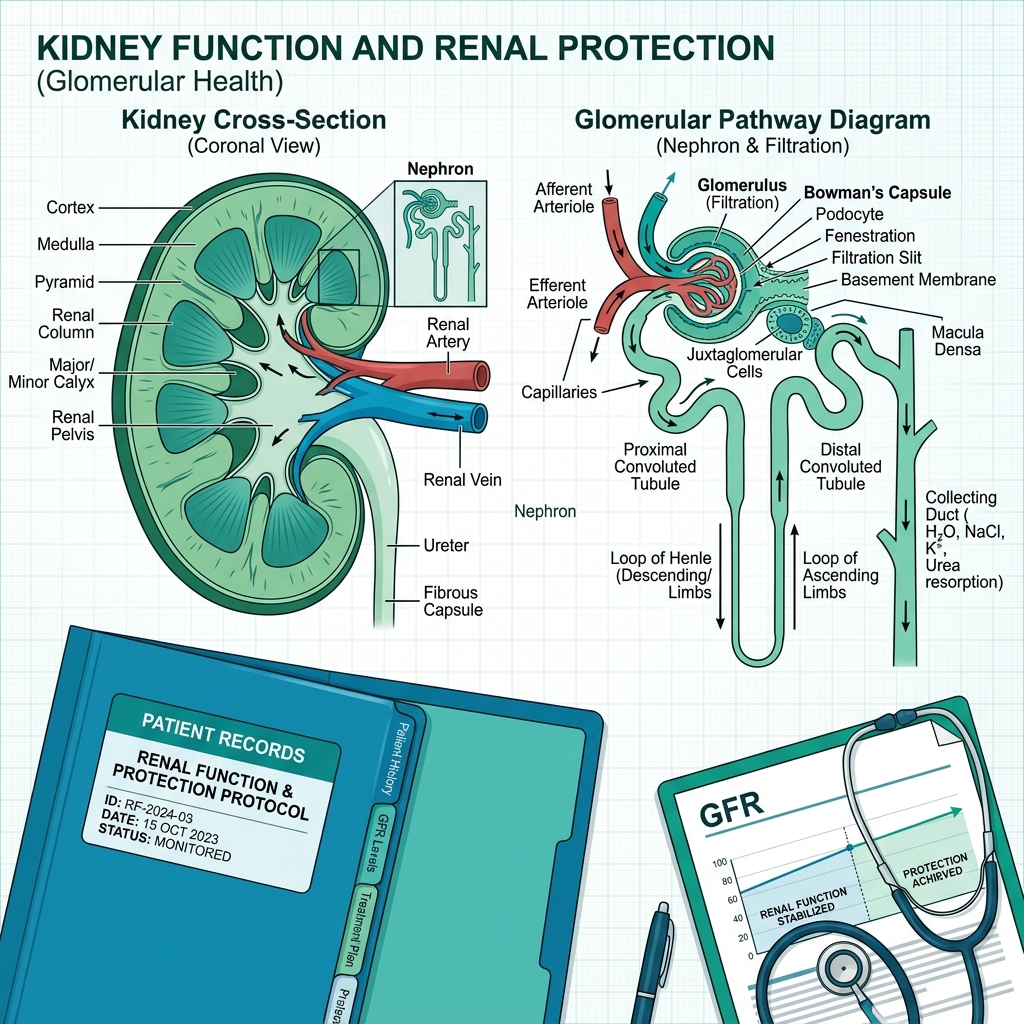
- 24% Reduction in Primary Renal Events: The landmark FLOW trial (Perkovic et al., 2024) demonstrated that once-weekly semaglutide 1.0 mg reduced the risk of kidney disease progression, a sustained ≥50% decline in eGFR, kidney failure, and renal/cardiovascular death by 24% in patients with type 2 diabetes and CKD.
- Preserved eGFR Decline Slope: Patients treated with semaglutide experienced a significantly slower loss of kidney function over time, with a mean annual eGFR slope benefit of 1.16 mL/min/1.73m² compared to the placebo cohort.
- Direct Nephroprotective Mechanisms: Semaglutide goes beyond glucose control to protect the kidneys by activating GLP-1 receptors in renal vasculature, decreasing renal inflammation (NF-κB inhibition), mitigating oxidative stress, reducing glomerular hyperfiltration, and resolving pathological albuminuria.
- No Dose Adjustments Required: Pharmacokinetic data confirms semaglutide is cleared via peptide catabolism, not renal excretion. No dosage adjustments are required for patients with mild, moderate, or severe renal impairment (down to eGFR 15 mL/min/1.73m²).
- Dehydration & AKI Monitoring: While semaglutide is not directly nephrotoxic, severe gastrointestinal side effects can lead to volume depletion. Patients must maintain robust oral hydration to prevent prerenal acute kidney injury (AKI).
- Affordable Telehealth Integration: Patients seeking high-quality metabolic care can access compounded semaglutide through safe compounded semaglutide protocols at a flat rate of $79/mo, avoiding commercial price inflation.
Introduction: The Metabolic Burden on Renal Health
Chronic Kidney Disease (CKD) represents one of the most severe microvascular complications of metabolic syndrome, type 2 diabetes, and chronic hypertension. For decades, the therapeutic pipeline for diabetic nephropathy and metabolic-associated kidney disease was limited. Clinicians relied primarily on blood pressure control and renin-angiotensin-aldosterone system (RAAS) blockade using ACE inhibitors or ARBs. While these interventions offered moderate delay in disease progression, patients with advanced kidney damage faced a predictable trajectory toward end-stage renal disease (ESRD), requiring dialysis or renal transplantation.
The introduction of sodium-glucose cotransporter-2 (SGLT2) inhibitors established a new baseline of renal care, but a significant residual risk of kidney failure and cardiovascular-related mortality remained. Recently, clinical research has focused on the glucagon-like peptide-1 (GLP-1) receptor agonist class. Originally designed for glycemic control and subsequently utilized for chronic weight management, semaglutide has shown signs of renal protection in secondary cardiovascular safety trials, such as SUSTAIN-6. However, whether semaglutide could directly prevent primary renal outcomes in patients with established CKD remained an open question.
The landmark FLOW trial (Perkovic et al., 2024) addressed this question directly. As the first dedicated renal outcomes trial for a GLP-1 receptor agonist, FLOW evaluated the safety and efficacy of once-weekly semaglutide 1.0 mg in patients with type 2 diabetes and chronic kidney disease. This article provides a comprehensive analysis of the FLOW trial outcomes, details the cellular and hemodynamic mechanisms by which semaglutide protects renal microarchitecture, outlines clinical dosing guidelines for patients with renal impairment, and offers essential safety protocols to prevent acute kidney injury (AKI) secondary to dehydration.
1. The Pathophysiology of CKD in Metabolic Patients
To understand the clinical value of semaglutide's renal protection, it is necessary to examine the physiological cascade that drives metabolic-associated kidney damage. The development of diabetic nephropathy is a multi-step process initiated by chronic hyperglycemia, tissue inflammation, and hemodynamic disruption within the nephron.
Diabetic Nephropathy and Metabolic Stress
Persistent elevation of blood glucose leads to the non-enzymatic glycation of proteins and lipids, resulting in the accumulation of advanced glycation end-products (AGEs) in renal tissues. AGEs bind to their receptors (RAGE) on glomerular endothelial cells, mesangial cells, and podocytes, triggering the activation of the protein kinase C (PKC) pathway. This biochemical cascade stimulates the expression of transforming growth factor-beta (TGF-β), which induces the synthesis of extracellular matrix proteins. Structurally, this leads to thickening of the glomerular basement membrane and expansion of the mesangial matrix, narrowing the capillary lumens and compromising filtration efficiency.
Glomerular Hyperfiltration and Mechanical Strain
In patients with metabolic syndrome and diabetes, insulin resistance and glycemic fluctuations alter the tone of the arteriole networks supplying the glomerulus. Under healthy conditions, the kidneys regulate filtration pressure via tubuloglomerular feedback. However, in metabolic patients, increased glucose filtration stimulates sodium-glucose cotransporters (SGLTs) in the proximal tubule to reabsorb excess glucose alongside sodium. This depletion of sodium delivery to the macula densa in the distal tubule is sensed as a state of low perfusion, prompting the afferent arteriole to dilate.
Concurrently, local upregulation of angiotensin II causes vasoconstriction of the efferent arteriole. This hemodynamic combination—dilated inlet (afferent) and constricted outlet (efferent)—creates a state of glomerular hyperfiltration, markedly increasing the hydrostatic pressure within the glomerular capillaries. This elevated pressure places physical shear stress on the filtration barrier, particularly the highly specialized epithelial cells known as podocytes. Over time, podocytes suffer foot process effacement and detachment, disrupting the slit diaphragm and allowing proteins to leak into the urine, manifesting as albuminuria.
Glomerular hyperfiltration acts as a mechanical driver of CKD. The high capillary pressure damages podocytes, leading to progressive sclerosis (scarring) of the glomeruli, worsening proteinuria, and a steady decline in the estimated glomerular filtration rate (eGFR). Controlling hyperfiltration is a key target for preserving long-term kidney function.
For individuals seeking to understand how these metabolic pathways affect overall health, our complete guide to semaglutide outlines the drug's systemic actions on cardiovascular, metabolic, and adipose tissues.
2. The Landmark FLOW Trial: Clinical Design and Scope
The FLOW trial (Evaluate Renal Function with Semaglutide Once Weekly) was a multinational, double-blind, randomized, placebo-controlled, parallel-group trial designed to evaluate the efficacy of semaglutide in preventing major renal events in patients with type 2 diabetes and chronic kidney disease. The trial was registered under ClinicalTrials.gov (NCT04514367) and represented a collaboration across hundreds of clinical sites worldwide.
Patient Population and Inclusion Criteria
The FLOW trial enrolled 3,533 participants with type 2 diabetes and diagnosed chronic kidney disease. To ensure the study captured individuals at high risk for disease progression, the investigators used specific eGFR and urinary albumin-to-creatinine ratio (UACR) thresholds:
- Group A: eGFR of 50 to 75 mL/min/1.73m² combined with a high degree of albuminuria (UACR > 300 to 5000 mg/g).
- Group B: eGFR of 25 to 50 mL/min/1.73m² combined with moderate-to-high albuminuria (UACR > 200 to 5000 mg/g).
All participants were required to be on standard-of-care medical therapy, including the maximum tolerated dose of a RAAS blocker (either an ACE inhibitor or an ARB), unless clinically contraindicated. The cohort had a mean age of approximately 66 years, a mean duration of type 2 diabetes of 15 years, and a baseline mean eGFR of 47 mL/min/1.73m², indicating a population with established, moderate-to-severe renal impairment.
Study Protocol and Early Termination
Participants were randomized in a 1:1 ratio to receive either once-weekly subcutaneous semaglutide 1.0 mg (titrated using the standard escalation protocol of 0.25 mg for 4 weeks, 0.5 mg for 4 weeks, up to the 1.0 mg maintenance dose) or a matching placebo. The primary endpoint was a composite of five major clinical events:
- Onset of persistent kidney failure (defined as dialysis, renal transplantation, or a sustained eGFR < 15 mL/min/1.73m²).
- A sustained decrease of ≥50% in the eGFR from baseline.
- Death from kidney-related causes.
- Death from cardiovascular causes.
In October 2023, an independent Data Monitoring Committee conducted a pre-specified interim analysis. The committee determined that the trial had met its efficacy criteria early, demonstrating a clear therapeutic benefit. Following this recommendation, the trial was stopped early to allow patients in the placebo group to access the protective therapy. The final data was analyzed and published in the New England Journal of Medicine in May 2024 (Perkovic et al., 2024).
3. Primary and Secondary Outcomes of the FLOW Trial
The final results of the FLOW trial established weekly semaglutide as a powerful therapy for kidney protection. The data showed consistent benefits across the primary composite endpoint, individual renal markers, and secondary cardiovascular and mortality measures.
Primary Composite Endpoint: 24% Risk Reduction
Over a median follow-up of 3.4 years, the primary composite endpoint occurred in 331 participants (18.7%) in the semaglutide group compared to 410 participants (23.2%) in the placebo group. Treatment with semaglutide resulted in a **24% reduction in the risk of the primary composite outcome** (Hazard Ratio 0.76; 95% Confidence Interval, 0.64 to 0.89; P = 0.0003). The Kaplan-Meier curves began to separate early in the study, and the therapeutic benefit remained consistent across subgroups, including those with baseline eGFRs below 30 mL/min/1.73m² and those on concurrent SGLT2 inhibitor therapy.
The primary outcome was a composite of kidney disease progression, severe loss of function, and renal or cardiovascular mortality. Key findings from Perkovic et al., 2024 include:
- Primary Composite Event: 24% reduction in risk (HR 0.76, P=0.0003)
- Sustained ≥50% eGFR Decline: 26% reduction in risk (HR 0.74)
- Cardiovascular Mortality: 29% reduction in risk (HR 0.71)
- All-Cause Mortality: 20% reduction in risk (HR 0.80)
Individual Renal Endpoints and Functional Preservation
Analysis of the individual components of the primary endpoint revealed significant improvements in kidney function:
- eGFR Decline Rate: The rate of loss of kidney function was significantly slower in the semaglutide group. The mean annual eGFR slope in the semaglutide cohort was -2.19 mL/min/1.73m², compared to -3.38 mL/min/1.73m² in the placebo group. This represents an annual preservation benefit of 1.16 mL/min/1.73m² (P < 0.0001).
- Albuminuria Reduction: Urinary protein excretion is a key clinical marker of renal damage. Semaglutide led to a **32% decrease in the UACR** within the first year of treatment, whereas the placebo group showed a slight increase in proteinuria.
Secondary Outcomes: Cardiovascular and Survival Benefits
Patients with chronic kidney disease are at significantly higher risk for cardiovascular complications. Indeed, CKD patients are more likely to die from a cardiovascular event than to progress to end-stage renal failure. The FLOW trial highlighted semaglutide's broad protective benefits:
- Major Adverse Cardiovascular Events (MACE): The risk of a composite cardiovascular event (nonfatal myocardial infarction, nonfatal stroke, or cardiovascular death) was reduced by **18%** in the semaglutide group (HR 0.82; 95% CI, 0.68 to 0.98; P = 0.029).
- All-Cause Mortality: Most notably, semaglutide reduced the risk of death from any cause by **20%** compared to placebo (HR 0.80; 95% CI, 0.67 to 0.95; P = 0.010).
These findings align with the cardiac benefits demonstrated in our review of the GLP-1 cardiovascular health benefits, highlighting how GLP-1 agonists provide systemic protection across both cardiac and renal vascular systems.
3. Physiological Mechanisms of GLP-1 Nephroprotection
The kidney protection shown in the FLOW trial cannot be explained solely by improvements in blood sugar control. While semaglutide does improve glycemic control, the degree of GFR preservation and the reduction in albuminuria went beyond what is typically achieved by glucose lowering alone. Research suggests that GLP-1 receptor agonists protect the kidneys through direct cellular, hemodynamic, and anti-inflammatory pathways.
| Protective Mechanism | Physiological Target | Clinical Outcome |
|---|---|---|
| Inhibition of NHE3 | Proximal Tubule Epithelium | Reduces intraglomerular pressure & hyperfiltration |
| Anti-Inflammatory Action | Renal Vasculature / Macrophages | Decreases TNF-α, IL-6, and interstitial fibrosis |
| Oxidative Stress Reduction | Mesangial & Glomerular Endothelial Cells | Downregulates ROS, preventing podocyte apoptosis |
| Podocyte Stabilization | Epithelial Slit Diaphragm | Mitigates albuminuria (proteinuria) |
Renal GLP-1 Receptor Expression
In the human kidney, glucagon-like peptide-1 receptors (GLP-1R) are expressed primarily on the smooth muscle cells of the renal vasculature, the afferent arterioles, and the brush border of the proximal tubule epithelial cells. Activation of these receptors initiates intracellular cascades that help protect the kidney's filtration structures.
Hemodynamic Regulation and Resolution of Hyperfiltration
A key mechanism of semaglutide's kidney protection is its ability to modulate the **sodium-hydrogen exchanger 3 (NHE3)** located in the microvilli of the proximal tubule. By inhibiting NHE3, semaglutide reduces the reabsorption of sodium and water in the early nephron. This increases the delivery of sodium and chloride to the macula densa in the distal tubule.
When the macula densa detects this increase in solute delivery, it triggers **tubuloglomerular feedback (TGF)**, which causes vasoconstriction of the afferent arteriole. This constriction reduces the hydrostatic pressure within the glomerular capillary bed, resolving hyperfiltration and protecting podocytes from mechanical damage and detachment. This pressure-lowering effect is similar to the hemodynamic mechanisms of ACE inhibitors and SGLT2 inhibitors, and the therapies appear to offer complementary benefits when used together.
Mitigation of Renal Inflammation and Interstitial Fibrosis
Chronic inflammation is a key driver of progressive kidney damage. GLP-1 receptor activation in renal endothelial cells and circulating immune cells helps suppress the nuclear factor kappa B (NF-κB) pathway. Under metabolic stress, NF-κB stimulates the transcription of proinflammatory genes, leading to the release of cytokines like tumor necrosis factor-alpha (TNF-α), interleukin-6 (IL-6), and monocyte chemoattractant protein-1 (MCP-1).
By inhibiting NF-κB, semaglutide reduces the expression of these cytokines, limiting the infiltration of inflammatory macrophages and T cells into the tubulointerstitial space. This dampens the local inflammatory response and prevents the activation of fibroblasts, which helps reduce the progressive scarring (interstitial fibrosis) that leads to loss of kidney function.
Oxidative Stress Reduction and Endothelial Preservation
GLP-1 receptor agonists also help protect the kidneys from oxidative damage. Chronic hyperglycemia stimulates the activity of NADPH oxidase (particularly NOX4) in glomerular mesangial and endothelial cells, generating large amounts of reactive oxygen species (ROS). These ROS damage lipids, proteins, and DNA, leading to endothelial dysfunction and podocyte death.
Semaglutide downregulates NOX4 expression while promoting the activity of endogenous antioxidant enzymes, such as superoxide dismutase (SOD) and catalase. This helps restore the redox balance within the glomerulus, protecting the endothelial glycocalyx and preserving the structural integrity of the glomerular filtration barrier.
Compounded Semaglutide Weight Loss Program — $79/mo
Access pharmaceutical-grade compounded semaglutide online. Connect with licensed providers, receive personalized dosing, and get free insulated cold-chain shipping directly to your door.
Start Your Assessment4. Dosing Guidelines and Safety in Renal Impairment
For patients with kidney disease, medication safety and correct dosing are key concerns. Fortunately, clinical data and pharmacological guidelines confirm that semaglutide is safe and effective in patients with varying degrees of renal impairment.
Pharmacokinetics and Clearance Pathways
Many common medications, such as metformin or SGLT2 inhibitors, require dose adjustments or discontinuation as kidney function declines because they rely on renal excretion. In contrast, semaglutide is a 31-amino-acid peptide with 94% structural homology to human GLP-1. It is modified with a C18 diacid chain at Lys26 and an alpha-aminoisobutyric acid (Aib) substitution at position 8 to resist degradation by the enzyme dipeptidyl peptidase-4 (DPP-4).
Because of its peptide structure, semaglutide is cleared through cellular catabolism and proteolytic cleavage throughout the body, rather than active renal excretion of the intact drug. Pharmacokinetic studies show that renal impairment does not significantly alter the drug's plasma concentration, half-life, or overall clearance rate. Consequently, **no dose adjustments are required for patients with mild, moderate, or severe renal impairment** (down to an eGFR of 15 mL/min/1.73m²).
Renal Impairment Dosing Guidelines
- Mild Renal Impairment (eGFR 60 to 89 mL/min/1.73m²): Standard titration and maintenance dosing. No special precautions are necessary beyond routine clinical care.
- Moderate Renal Impairment (eGFR 30 to 59 mL/min/1.73m²): Standard titration and maintenance dosing. No dose reduction is required. This is the population that demonstrated significant benefit in the FLOW trial.
- Severe Renal Impairment (eGFR 15 to 29 mL/min/1.73m²): Standard titration and maintenance dosing. No initial dose adjustments are necessary. However, patients with severe CKD have reduced reserve capacity, so close clinical monitoring of hydration status and renal biomarkers is recommended during dose escalation.
- End-Stage Renal Disease (eGFR < 15 mL/min/1.73m² or on Dialysis): Clinical data in this population is limited. The use of semaglutide is not currently recommended for patients with ESRD or those undergoing dialysis unless managed by a nephrologist.
Patients interested in the safety profile of compounded GLP-1 formulations can refer to our detailed review, is compounded semaglutide safe?, which examines sterility, compounding standards, and clinical safety measures.
5. Preventing Acute Kidney Injury (AKI) and Volume Depletion
Although semaglutide has no direct nephrotoxic effects, clinical monitoring is essential because of the risk of **acute kidney injury (AKI)** secondary to severe gastrointestinal side effects. Understanding this risk and following proper hydration protocols are key to patient safety.
The Physiological Link Between GI Distress and AKI
GLP-1 receptor agonists can cause dose-dependent gastrointestinal side effects, including nausea, vomiting, and diarrhea, particularly during the initial titration phase. In patients with compromised kidney function, persistent vomiting or diarrhea can quickly lead to volume depletion, hypovolemia, and dehydration.
When intravascular volume drops, renal perfusion pressure decreases. The kidneys attempt to maintain GFR by dilating the afferent arteriole and constricting the efferent arteriole (driven by renin and angiotensin II). However, in patients who are already taking ACE inhibitors, ARBs, or NSAIDs, these compensatory mechanisms are blocked. This can lead to a sudden decline in renal blood flow and cause **prerenal acute kidney injury (AKI)**. In patients with pre-existing CKD, an episode of AKI can accelerate the progression of chronic kidney disease.
Hydration and Monitoring Protocols
To minimize the risk of volume depletion and protect renal function, patients and clinical teams should follow these guidelines:
- Maintain Hydration: Patients should drink plenty of fluids, aiming for at least 64 to 80 ounces of water daily. If they experience mild nausea, vomiting, or diarrhea, they should supplement with electrolyte solutions (such as oral rehydration salts, sports drinks, or bone broths) to replace lost sodium and potassium.
- Monitor for Dehydration: Patients should watch for signs of dehydration, including dark urine, decreased urine output, dry mouth, dizziness, or orthostatic hypotension (feeling lightheaded when standing up).
- Follow "Sick Day Rules": If a patient experiences severe, persistent vomiting or diarrhea and cannot keep fluids down, they should contact their healthcare provider immediately. Under medical supervision, they should temporarily pause their semaglutide dose and any concurrent blood pressure medications (especially ACE inhibitors, ARBs, and diuretics) until they are fully rehydrated.
- Routine Lab Monitoring: For patients with baseline eGFR < 45 mL/min/1.73m², providers should monitor renal function (serum creatinine, eGFR) and electrolytes before starting therapy, after dose increases, and during any episodes of illness or gastrointestinal distress.
6. Clinical Integration: Compounded Semaglutide Efficacy
As the clinical benefits of semaglutide expand to include weight loss, cardiovascular risk reduction, and kidney protection, demand for this peptide has increased. However, the high retail price of brand-name Wegovy® and Ozempic® (often exceeding $1,000 to $1,300 per month) remains a significant barrier for many patients.
To help improve access, telehealth programs partner with licensed compounding pharmacies to offer compounded semaglutide. Compounded semaglutide contains the identical active molecule (semaglutide) as the brand-name versions. It acts on the same GLP-1 receptors and has the same physiological actions, offering an affordable, clinically equivalent option for metabolic and weight care.
Losing Weight RX provides access to compounded semaglutide programs starting at a flat rate of **$79 per month**. This program includes medical evaluation by licensed providers, prescription management, and expedited cold-chain shipping, helping patients access this therapeutic peptide without high insurance copays or deductibles.
Begin Your Clinical Weight Care Protocol for $79/mo
Achieve sustainable weight management with the same active molecule studied in landmark cardiovascular and renal outcome trials. Under the care of licensed U.S. medical providers.
Get Started TodayFrequently Asked Questions
The FLOW trial was a randomized, double-blind, placebo-controlled study designed to evaluate whether once-weekly semaglutide 1.0 mg could prevent major kidney disease outcomes in patients with type 2 diabetes and chronic kidney disease (CKD). It is a landmark trial because it is the first cardiovascular and renal outcomes trial designed specifically with kidney disease progression as its primary endpoint. The trial demonstrated a 24% reduction in the risk of renal events, cardiovascular death, and eGFR decline.
No. Unlike many other medications, semaglutide does not require dosage adjustments for patients with mild, moderate, or severe renal impairment, down to an estimated glomerular filtration rate (eGFR) of 15 mL/min/1.73m². Its clearance occurs via proteolytic degradation and cellular catabolism rather than active renal excretion of the intact drug. However, close clinical monitoring is necessary in patients with severe CKD to prevent gastrointestinal-induced dehydration.
Semaglutide protects the kidneys through direct and indirect pathways: it reduces systemic and local renal inflammation, decreases oxidative stress by downregulating reactive oxygen species, prevents podocyte damage, mitigates protein leakage (albuminuria), and resolves glomerular hyperfiltration. Additionally, it helps lower systemic blood pressure and blood sugar, which reduces mechanical and metabolic stress on the nephrons.
Glomerular hyperfiltration is a state where the kidneys filter blood at an abnormally high pressure, stretching and injuring the glomerular capillary walls. GLP-1 receptor activation inhibits the sodium-hydrogen exchanger 3 (NHE3) in the proximal tubule, causing more sodium to reach the macula densa. This triggers tubuloglomerular feedback, leading to vasoconstriction of the afferent arteriole. This constriction reduces the hydrostatic pressure inside the glomerulus, preventing podocyte injury and slowing GFR decline.
Semaglutide does not cause direct nephrotoxicity. However, severe gastrointestinal side effects—such as persistent nausea, vomiting, or diarrhea—can lead to severe dehydration and hypovolemia. This loss of fluid volume can cause prerenal acute kidney injury (AKI). Patients can prevent this by maintaining adequate oral hydration with water and electrolytes, and pausing the medication temporarily under medical supervision during severe illnesses (sick day rules).
Yes, compounded semaglutide contains the identical active pharmaceutical ingredient (semaglutide) as brand-name Wegovy® and Ozempic®. It works through the same biological mechanisms to stimulate GLP-1 receptors, promoting weight loss and offering the same systemic and renal benefits. Patients must obtain compounded semaglutide from a licensed telehealth provider that partners with state-licensed, PCAB-accredited compounding pharmacies to ensure drug quality and sterile preparation.
Clinical References & Sources
- Perkovic, V., Tuttle, K. R., Rossing, P., et al. (2024). Effects of semaglutide on chronic kidney disease in patients with type 2 diabetes. New England Journal of Medicine, 391(2), 109-121. PubMed
- Mann, J. F. E., et al. (2017). Semaglutide and cardiovascular outcomes in patients with type 2 diabetes. New England Journal of Medicine, 377(9), 314-322. PubMed
- Mann, J. F. E., et al. (2017). Liraglutide and renal outcomes in type 2 diabetes. New England Journal of Medicine, 377(9), 839-848. PubMed