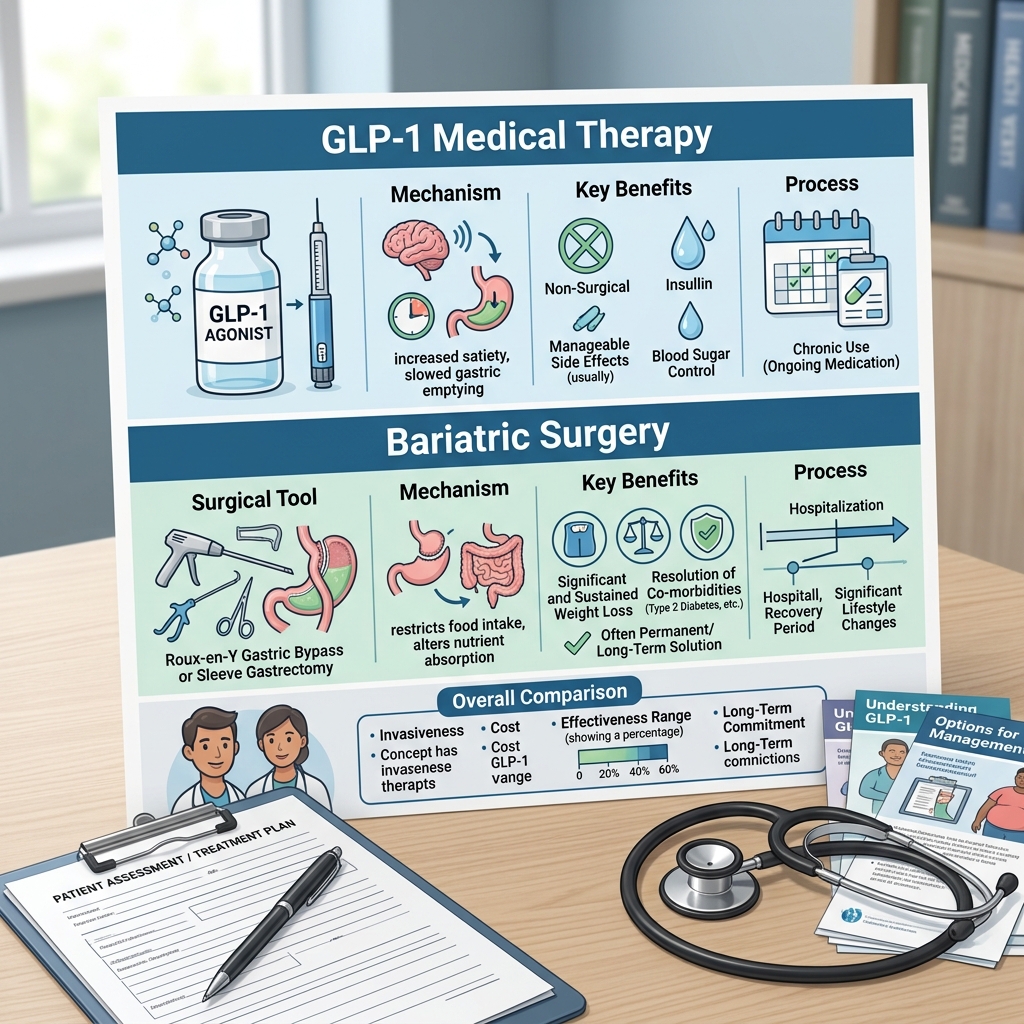
- Efficacy gap: Bariatric surgery achieves an average of 24–26% weight loss in real-world studies, compared to 5–7% for GLP-1 receptor agonists. However, in strict clinical trials, GLP-1s show 15–21% weight loss.
- Attrition limits real-world GLP-1 success: Real-world medication adherence is low, with up to 70% of GLP-1 patients discontinuing therapy within one year due to side effects, high cumulative out-of-pocket costs, or insurance barriers.
- Invasiveness and permanence: Bariatric surgery is a permanent, major abdominal procedure requiring lifelong vitamin supplementation, whereas GLP-1 therapy is a non-invasive weekly self-injection.
- Financial tradeoffs: Surgery has a high upfront cost ($15,000–$25,000) but is often covered by insurance. GLP-1 medications are rarely covered, presenting lower upfront but much higher cumulative lifetime costs. Affordable compounded alternatives ($79/mo flat) bridge this access gap.
For decades, metabolic bariatric surgery stood as the absolute gold standard for individuals suffering from severe obesity. It was the only clinical intervention capable of resetting the body's metabolic thermostat, resolving Type 2 diabetes, and producing profound, long-term weight reduction. Pharmacological treatments were historically ineffective and marred by severe stimulant-related side effects.
That landscape shifted dramatically with the approval of next-generation Glucagon-Like Peptide-1 (GLP-1) receptor agonists and dual GIP/GLP-1 agonists. These medications—including Semaglutide (Wegovy®, Ozempic®) and Tirzepatide (Zepbound®, Mounjaro®)—mimic natural gut hormones to suppress appetite, slow gastric emptying, and alter metabolic pathways in the brain. They have achieved weight loss percentages that for the first time rival surgical outcomes, sparking an intense clinical debate: GLP-1 medications versus bariatric surgery.
For patients navigating these options, the decision is rarely simple. It requires weighing surgical risks against a lifelong commitment to once-weekly injections, understanding the difference between clinical trials and real-world results, and calculating the long-term financial impacts of both choices. This evidence-based guide provides a detailed comparative analysis to help you make an informed decision for your health.
What Are GLP-1 Medications and Bariatric Surgery?
To compare these two treatment modalities, it is essential to first understand their physiological mechanisms. While both aim to reduce adipose tissue and correct metabolic dysfunction, they achieve these goals through completely different pathways.
GLP-1 Receptor Agonists: The Endocrine Path
GLP-1 receptor agonists are synthetic peptides administered via weekly subcutaneous injections. These medications replicate the action of the natural hormone glucagon-like peptide-1, which is released by the distal gut in response to food intake. At the molecular level, GLP-1s target three primary organ systems:
- The Brain: By crossing the blood-brain barrier, they bind to receptors in the hypothalamus, the homeostatic center regulating hunger and satiety. This action significantly dampens the subjective drive to eat, silencing the constant mental preoccupation with food commonly referred to as "food noise."
- The Stomach: They delay gastric emptying, slowing down the physical transit of food from the stomach to the small intestine. This prolongs gastric distension, signaling fullness to the brain for hours after eating small portions.
- The Pancreas: They stimulate insulin secretion in a glucose-dependent manner, suppressing glucagon release. This lowers circulating blood glucose and stabilizes insulin spikes, helping to correct systemic insulin resistance.
Bariatric Surgery: The Anatomical Path
Bariatric surgery—also referred to as metabolic and bariatric surgery (MBS)—is a laparoscopic or robotic surgical procedure that permanently restructures the gastrointestinal tract. The two most common procedures performed in 2026 are:
- Sleeve Gastrectomy: A surgeon removes approximately 80% of the stomach, leaving a narrow, banana-shaped gastric tube or "sleeve." This strictly limits the physical volume of food the stomach can hold. It also removes the fundus of the stomach, which is the primary site of ghrelin (the "hunger hormone") production.
- Roux-en-Y Gastric Bypass (RYGB): The surgeon creates a tiny gastric pouch (about the size of an egg) and bypasses the remaining stomach and the upper portion of the small intestine. This introduces both physical restriction and calorie malabsorption, while triggering rapid shifts in bile acid flow and gut microbiomes that stimulate the release of endogenous GLP-1 and PYY.
While surgery is a mechanical, anatomical modification that secondarily alters hormones, GLP-1 therapy is a chemical, hormonal modification that works directly on cellular receptors. Let's examine how these distinct mechanisms perform when put to the test.
How Do Weight Loss Results Compare in Clinical Trials vs. the Real World?
Evaluating weight loss efficacy requires looking at two distinct pools of data: the idealized, highly monitored environment of clinical trials, and the complex, messy reality of real-world patient registries.
Efficacy in Clinical Trials: The Head-to-Head Estimate
In double-blind, randomized controlled trials, both interventions perform exceptionally well. For GLP-1 receptor agonists, the landmark clinical trials set historical benchmarks:
- Semaglutide: The STEP 1 clinical trial demonstrated a mean weight loss of 14.9% to 16.0% of baseline body weight over 68 weeks.
- Tirzepatide: The SURMOUNT-1 clinical trial, evaluating the dual GIP/GLP-1 agonist, showed an average weight loss of 20.9% to 22.5% of baseline body weight at the highest dose (15 mg) over 72 weeks.
In contrast, clinical trials for bariatric surgery demonstrate slightly higher, more rapid weight loss. Over a similar 1-to-2-year timeline, Sleeve Gastrectomy patients lose an average of 25% to 30% of baseline weight, while Roux-en-Y Gastric Bypass patients achieve 30% to 35% weight loss. The clinical trial data suggests that while surgery remains more potent, the gap has closed significantly with the advent of dual-incretin medications.
Efficacy in the Real World: The Attrition Reality
However, when looking at real-world data, the efficacy gap widens dramatically. In 2024, the American Society for Metabolic and Bariatric Surgery (ASMBS) presented a landmark real-world cohort study analyzing clinical outcomes for thousands of patients side-by-side. The results revealed a stark divergence:
- Bariatric Surgery Patients: Maintained an average weight loss of 24% to 26% at the one-year mark.
- GLP-1 Medication Patients: Achieved an average weight loss of only 5% to 7% at the one-year mark.
Why is there such a massive discrepancy between GLP-1 clinical trials (15–21%) and real-world GLP-1 weight loss (5–7%)? The answer lies in long-term adherence and attrition rates. In clinical trials, patients receive free medications, regular coaching, and direct monitoring. In the real world, patients face high out-of-pocket costs, insurance changes, supply shortages, and side effects. Because bariatric surgery is a permanent, non-discontinuable physical modification, its real-world efficacy remains highly durable. For GLP-1 medications, the weight loss is only active while the drug is in the system, making adherence the single most critical factor in real-world success.
How Do Comorbidity Remission Rates Compare Long-Term?
Obesity is rarely an isolated condition; it is almost always accompanied by metabolic diseases such as Type 2 diabetes, hypertension, and obstructive sleep apnea. Resolving these diseases—known as comorbidity remission—is often a more critical medical objective than aesthetic weight loss.
Type 2 Diabetes Remission
Bariatric surgery has a profound, almost immediate effect on Type 2 diabetes. In the landmark clinical trial conducted by Schauer et al. (2012) and published in the New England Journal of Medicine, researchers compared intensive medical therapy against bariatric surgery for patients with Type 2 diabetes. The three-year follow-up showed that bariatric surgery was significantly superior to intensive medical therapy, with 38% of gastric bypass patients and 24% of sleeve gastrectomy patients achieving complete glycemic control (HbA1c ≤ 6.0%) without any diabetes medications, compared to just 5% in the medical therapy cohort.
GLP-1 medications also show high glycemic efficacy. They reduce HbA1c levels by an average of 1.5% to 2.0% and can induce diabetes remission in early-stage patients. However, there is a catch: glycemic control is strictly drug-dependent. A retrospective cohort study by Aravani et al. (2023) in The Lancet Diabetes & Endocrinology compared long-term weight loss and comorbidity remission between surgical patients and those on GLP-1 receptor agonists. The study showed that while surgical patients maintained stable diabetes remission over five years, patients on GLP-1s experienced a rapid return of hyperglycemia and HbA1c elevation if they discontinued their medication.
Cardiovascular Disease and Sleep Apnea
Both treatments reduce major adverse cardiovascular events (MACE). The SELECT trial demonstrated that Semaglutide reduces the risk of heart attack, stroke, and cardiovascular death by 20% in patients with overweight or obesity. Similarly, long-term bariatric registries show a 30% to 40% reduction in all-cause mortality over ten years, driven by the resolution of obstructive sleep apnea and systemic hypertension. Surgery tends to produce more rapid and permanent resolution of severe sleep apnea due to the larger volume of tissue lost in the neck area, while GLP-1s require sustained weight loss to match those improvements.
Bypass Insurance Prior Authorization Exclusions
If you're seeking the metabolic benefits of GLP-1 therapy but face insurance denials, Losing Weight RX offers flat-rate compounded semaglutide for $79/mo. Connect with a U.S. licensed provider online in minutes.
Start Your AssessmentWhat Are the Long-Term Discontinuation and Attrition Rates?
When comparing a lifelong medical treatment with a one-time surgical procedure, the rate at which patients drop out of therapy over time is a critical, and often overlooked, variable.
GLP-1 Attrition: The 70% Drop-off
Long-term adherence is the primary challenge facing GLP-1 therapy. Epidemiological data in 2026 shows that up to 70% of patients who start a brand-name GLP-1 medication discontinue the drug within 12 months. The primary reasons for this high attrition rate are:
- Insurance Coverage De-provisioning: Many commercial insurers initially approve GLP-1 coverage under strict criteria, only to drop coverage or demand burdensome prior authorizations at the end of the year, forcing patients to stop treatment.
- Prohibitive Retail Costs: For patients paying out-of-pocket, the retail list price of $1,000 to $1,300+ per month is financially unsustainable for more than a few months.
- Chronic GI Side Effects: While nausea, diarrhea, and constipation are usually temporary, a subset of patients suffers from persistent, low-grade gastrointestinal discomfort that eventually leads them to stop the weekly injections.
Because stopping GLP-1 medications results in the return of appetite and slow metabolism, stopping therapy almost always leads to rapid weight regain. The STEP 4 trial showed that patients who switched to a placebo after 20 weeks on semaglutide regained 6.9% of their body weight over the next 48 weeks, while those who remained on the drug lost an additional 7.9%.
Bariatric Surgery Permanence
Bariatric surgery does not suffer from medication adherence issues. Once the procedure is performed, the stomach's physical size and anatomical pathways are permanently altered. There is no prescription to refill and no weekly dose to remember. However, surgery does have its own version of attrition: surgical revision and failure rates. Approximately 10% to 15% of bariatric surgery patients experience significant weight regain within 5 to 10 years, and roughly 5% to 10% eventually require a surgical revision (such as converting a sleeve gastrectomy into a gastric bypass) due to severe acid reflux or pouch stretching.
What Are the Risks and Complications of Each Treatment?
Safety is the area where the two treatments diverge most significantly. Patients must decide if they are more comfortable with the high-consequence, upfront risks of surgery, or the low-consequence, long-term side effects of medication.
GLP-1 Medication Risks and Side Effects
GLP-1 receptor agonists are generally considered safe, but they are associated with a high frequency of minor side effects and a small risk of serious conditions:
- Gastrointestinal Distress: Up to 50% of patients experience nausea, vomiting, diarrhea, or constipation during the initial titration phases.
- Gallbladder Disease: Rapid weight loss and GLP-1 receptor stimulation can increase the risk of cholecystitis (gallbladder inflammation) and gallstones by up to 2.5 times.
- Pancreatitis: Acute pancreatitis is a rare but serious risk, occurring in less than 0.2% of treated patients. It requires immediate discontinuation of the medication.
- Sarcopenia (Muscle Loss): Rapid weight loss on GLP-1s can lead to significant loss of skeletal muscle mass. If protein intake is inadequate and resistance exercise is not performed, up to 40% of the weight lost on GLP-1s can come from lean muscle tissue.
Bariatric Surgery Risks and Complications
Bariatric surgery is a major surgical procedure performed under general anesthesia. It carries both immediate post-operative risks and long-term metabolic complications:
- Acute Surgical Risks (1–2%): These include staple-line leaks, internal bleeding, deep vein thrombosis (DVT), pulmonary embolism, and surgical site infections. Staple-line leaks are particularly serious and require hospitalization and sometimes emergency re-operation.
- Dumping Syndrome: Common in gastric bypass patients, this occurs when high-sugar foods pass too rapidly into the small intestine, causing severe nausea, cramping, sweating, diarrhea, and reactive hypoglycemia.
- Severe Nutritional Deficiencies: Because gastric bypass bypasses the duodenum (where most vitamins are absorbed), patients face a lifelong risk of severe iron-deficiency anemia, osteoporosis (due to calcium malabsorption), and vitamin B12 deficiencies. Surgical patients must take specialized, high-dose bariatric multivitamins daily for the rest of their lives.
- Anatomical Obstructions: Internal hernias and bowel obstructions occur in 1% to 3% of gastric bypass patients, requiring emergency surgery to correct.
GLP-1 vs. Bariatric Surgery: Structured Comparison Table
The following structured comparison illustrates the clear clinical, operational, and financial trade-offs between medical GLP-1 therapy and metabolic bariatric surgery.
| Evaluation Factor | GLP-1 Receptor Agonists (Medication) | Bariatric Surgery (Gastric Bypass/Sleeve) |
|---|---|---|
| Primary Mechanism | Chemical hormone mimicry; central appetite suppression & delayed gastric emptying. | Mechanical restriction of stomach volume & malabsorption of calories. |
| Clinical Trial Weight Loss | 15% to 22.5% total body weight loss at 1–2 years. | 25% to 32% total body weight loss at 1–2 years. |
| Real-World Weight Loss | 5% to 7% mean weight loss at 1 year (due to attrition). | 24% to 26% mean weight loss at 1 year. |
| Comorbidity Remission | High remission rates for diabetes/hypertension, but relies on drug continuation. | Profound, durable remission (e.g., 38% drug-free diabetes remission at 3 years). |
| Discontinuation / Reversibility | Up to 70% stop within 1 year. Reversible; weight gain occurs after stopping. | Permanently alters anatomy. Non-discontinuable; <10% require revision. |
| Invasiveness | Non-invasive; self-administered weekly subcutaneous injection. | Highly invasive; laparoscopic major abdominal surgery under general anesthesia. |
| Long-Term Costs | High recurring costs: $150 to $1,300/mo indefinitely ($18k–$130k+ over 10 years). | High upfront ($15k–$25k) but minimal long-term maintenance costs. |
GLP-1 Receptor Agonists (Medication)
Bariatric Surgery (Surgical)
How Do the Costs Compare: Short-Term vs. Long-Term?
The financial math of choosing between medical and surgical obesity treatment is a critical factor for most patients. The decision represents a choice between a high, one-time upfront cost and a lower, recurring monthly cost that accumulates over time.
Bariatric Surgery Costs
The cash-pay price for a laparoscopic sleeve gastrectomy or gastric bypass ranges from $15,000 to $25,000. However, because bariatric surgery has been recognized as a highly effective metabolic intervention for decades, it is **widely covered by insurance.** Most commercial insurance plans, Medicare, and Medicaid cover bariatric surgery if the patient has a BMI ≥ 40, or ≥ 35 with at least one obesity-related comorbidity (like Type 2 diabetes or sleep apnea). If covered, the patient's out-of-pocket cost is often limited to their standard deductible ($500 to $3,000).
GLP-1 Medication Costs
GLP-1 medications represent a different financial structure. The list price for brand-name Wegovy® is $1,349 per month, and Zepbound® is $1,060 per month. Because obesity medications are widely excluded from insurance formularies, most patients must pay these retail prices out-of-pocket. Even with manufacturer coupons, the cost is rarely lower than $550 per month. Over a ten-year period, paying retail for a brand-name GLP-1 costs approximately $130,000 to $160,000—a massive financial barrier that explains why up to 70% of real-world patients discontinue therapy within a year.
To bridge this financial access gap, compounding pharmacy protocols have emerged as a vital option. Under section 503A of the FD&C Act, licensed compounding pharmacies can legally prepare compounded versions of Semaglutide and Tirzepatide using the identical active pharmaceutical ingredients, bypassing the brand-name commercial markups. Through telehealth platforms like Losing Weight RX, patients can access compounded Semaglutide for a flat rate of $79 per month, including doctor consultations and cold-chain shipping. This brings the annual cost down to $948, or $17,520 over ten years, making long-term compliance achievable for patients without insurance coverage.
Invasiveness, Commitment, and Lifestyle: Which Path Fits You?
Choosing between medical GLP-1 therapy and bariatric surgery is not merely a clinical calculation. It is a highly personal decision that depends on your tolerance for risk, your lifestyle, and your long-term goals. Here is a practical decision framework:
Choose GLP-1 Therapy If:
- You want a non-invasive, reversible approach and want to avoid the risks of major surgery, general anesthesia, and permanent anatomical restructuring.
- Your BMI is between 27 and 35, making you ineligible for bariatric surgery but a perfect candidate for GLP-1 therapy.
- You are comfortable with a long-term treatment plan involving weekly injections to maintain your weight loss and metabolic improvements.
- You want to maintain a normal digestive anatomy, avoiding the risk of dumping syndrome and severe nutritional malabsorption.
Choose Bariatric Surgery If:
- Your BMI is over 40 (or over 35 with severe comorbidities) and you meet the clinical insurance requirements, allowing you to access the procedure with minimal out-of-pocket costs.
- You want a one-time physical intervention and want to avoid the financial and logistial commitment of lifelong weekly injections.
- You suffer from advanced, uncontrolled Type 2 diabetes and want the highest possible chance of immediate, drug-free remission.
- You are willing to accept the surgical risks and commit to the mandatory daily bariatric vitamin regimen required for life.
Determine Your Best Metabolic Path Today
If bariatric surgery is too invasive or out of reach, next-generation GLP-1 therapies can help. Complete your online health assessment with Losing Weight RX and a licensed provider will design a personalized clinical weight management plan.
Start Your AssessmentFrequently Asked Questions
In clinical trials, bariatric surgery (such as gastric bypass or sleeve gastrectomy) yields an average of 25% to 32% weight loss, compared to 15% to 22.5% for GLP-1 medications (like semaglutide and tirzepatide). In real-world studies, the difference is wider (5-7% weight loss at one year for GLP-1 vs 24-26% for bariatric surgery), primarily because of high medication discontinuation rates.
Bariatric surgery is a permanent, invasive surgical procedure under general anesthesia, carrying acute risks like infection, bleeding, leaks, and anesthesia complications, and long-term risks like dumping syndrome, acid reflux, bowel obstruction, and nutritional deficiencies. GLP-1s are non-surgical, with side effects primarily limited to temporary gastrointestinal issues (nausea, vomiting, diarrhea, constipation), though they carry rare risks of pancreatitis and gallbladder disease.
Yes, clinical trials (like the STEP 4 trial) show that most patients regain a significant portion of their lost weight once they stop taking GLP-1 medications. Obesity is a chronic disease, so GLP-1 receptor agonists are designed for long-term or lifetime maintenance, whereas bariatric surgery is a one-time anatomical alteration that provides permanent restriction and metabolic changes (though some weight regain can still occur).
Historically, bariatric surgery is widely covered by health insurance plans (including Medicare and Medicaid) for individuals with a BMI over 40, or a BMI over 35 with severe comorbidities, provided they meet specific clinical criteria. In contrast, many insurance plans explicitly exclude weight loss medications like Wegovy® and Zepbound® from their formularies, leading to high out-of-pocket costs unless using affordable compounded alternatives.
In clinical trials, patients receive intensive lifestyle coaching, free medication, and close monitoring, leading to high compliance. In the real world, up to 70% of patients discontinue GLP-1 medications within one year due to high costs, insurance coverage loss, side effects, or drug supply shortages. This high attrition rate drops the average real-world weight loss to 5-7% at one year, whereas surgery (which cannot be "discontinued") maintains 24-26% average real-world weight loss.
Yes. Many patients who do not qualify for or wish to avoid the risks of invasive surgery turn to GLP-1 receptor agonists. Because brand-name GLP-1 medications can cost over $1,000 per month out-of-pocket due to insurance exclusions, compounded semaglutide from platforms like Losing Weight RX offers an accessible, FDA-permitted alternative at a flat rate of $79 per month, with no insurance required.
Clinical References & Sources
- American Society for Metabolic and Bariatric Surgery (ASMBS). (2026). "Bariatric surgery significantly more effective than GLP-1 drugs for weight loss and disease remission, large real-world study finds." ASMBS News Link
- Schauer, P. R., et al. (2012). "Bariatric Surgery versus Intensive Medical Therapy for Diabetes — 3-Year Outcomes." New England Journal of Medicine, 370(21), 2002-2013. NEJM Link
- Aravani, A., et al. (2023). "Long-term weight loss and comorbidity remission after bariatric surgery vs. GLP-1 receptor agonists: a retrospective cohort study." The Lancet Diabetes & Endocrinology. The Lancet Link