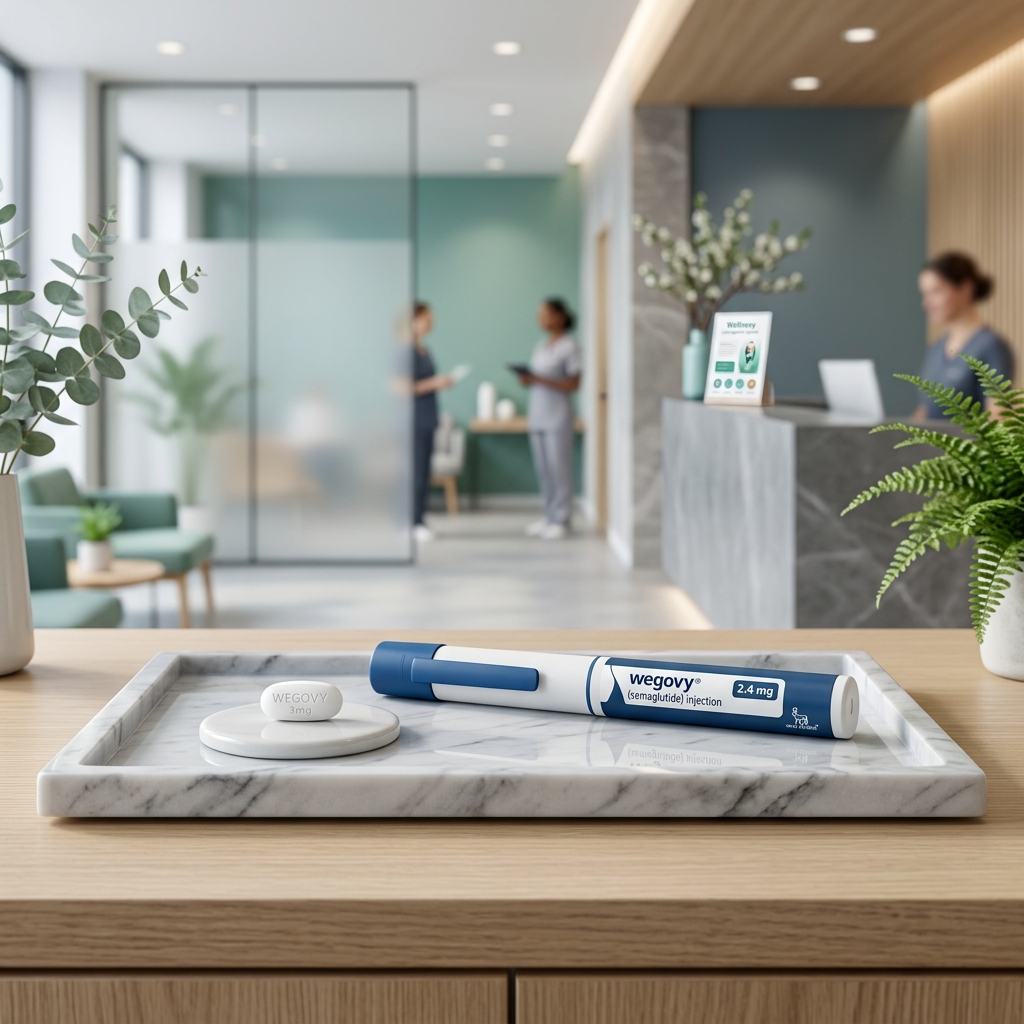
- Efficacy parity: The clinical efficacy of high-dose daily oral semaglutide (50 mg) is nearly identical to weekly injectable semaglutide (2.4 mg Wegovy®), achieving a ~15.1% vs. ~14.9% average body weight loss over 68 weeks.
- Absorption barrier: Oral semaglutide has an extremely low bioavailability of under 1%. To compensate, a daily 50 mg tablet (totaling 350 mg per week) is required to achieve the same therapeutic concentration as a weekly 2.4 mg subcutaneous injection.
- Formulation science: The oral formulation requires co-processing with SNAC, an absorption enhancer that buffers stomach acids and enables the peptide molecule to cross the gastric mucosa.
- Administration protocol: The oral tablet has a strict morning protocol: taken on an empty stomach with no more than 4 ounces of water, followed by a 30-minute fast. The injection has no food or timing restrictions.
- Cost comparison: Injectable Wegovy® lists at $1,349/mo, while diabetes-dosed oral Rybelsus® lists at ~$935/mo. Compounded injectable semaglutide via Losing Weight RX offers the same active molecule at a flat-rate of $79/mo with no insurance required.
Introduction: The Evolution of GLP-1 Weight Loss Delivery
The landscape of medical weight loss has been revolutionized by GLP-1 (glucagon-like peptide-1) receptor agonists. Foremost among these is semaglutide, the active pharmaceutical ingredient in Novo Nordisk's blockbuster medications, Wegovy® and Ozempic®. Historically, semaglutide has been administered as a subcutaneous injection, which remains the most recognizable format for patients undergoing clinical weight management. However, the FDA's approval of oral formulations for type 2 diabetes and recent Phase 3 trial data evaluating high-dose oral semaglutide for obesity have sparked intense interest in the choice between "oral Wegovy" (the Wegovy pill or tablet) and the traditional injectable pen.
For patients, the choice is more than just a matter of avoiding needles. It involves understanding deep pharmacological differences, complex absorption mechanics in the gastrointestinal tract, variations in dosing frequency, tolerability curves, and substantial out-of-pocket costs. This clinical comparison guide breaks down the science of oral vs. injectable semaglutide, analyzing how they perform in clinical trials, how their bioavailability differs, and the practical and financial considerations of each route.
The Science of Semaglutide: Mechanism of Action
Regardless of whether semaglutide is swallowed as a tablet or injected into subcutaneous tissue, the primary active molecule is chemically identical. Semaglutide is a synthetic peptide that shares a 94% sequence homology with endogenous human GLP-1, a hormone naturally secreted by the L-cells of the small intestine in response to food intake. To prevent the rapid enzymatic degradation by dipeptidyl peptidase-4 (DPP-4)—which breaks down natural GLP-1 within minutes—the semaglutide molecule is modified with an amino acid substitution at position 8 and the attachment of a C18 fatty diacid spacer at position 26. This structural configuration allows the molecule to bind tightly to albumin, extending its biological half-life to approximately 7 days.
Once semaglutide enters systemic circulation, it crosses the blood-brain barrier to target GLP-1 receptors in the central nervous system, particularly within the arcuate nucleus of the hypothalamus. By activating these receptors, semaglutide mimics natural satiety cues, suppressing appetite, reducing cravings for energy-dense foods, and lowering the body's metabolic "set point." In the peripheral nervous system, semaglutide delays gastric emptying, keeping food in the stomach longer and extending postprandial fullness. In the pancreas, it stimulates insulin secretion and suppresses glucagon release in a glucose-dependent manner, thereby stabilizing blood sugar levels and preventing insulin spikes.
Pharmacokinetics and Bioavailability: The SNAC Breakthrough
The defining difference between oral and injectable semaglutide lies in how the drug enters the bloodstream. Subcutaneous injection delivers semaglutide directly into the adipose tissue layer, where it slowly diffuses into local capillaries and achieves virtually 100% bioavailability. The gastrointestinal tract is completely bypassed, ensuring that the full dose is absorbed without interference.
Swallowing a peptide drug like semaglutide, however, presents a massive physiological challenge. The stomach is an aggressive environment designed to digest proteins. Gastric acid denatures complex chains, and proteolytic enzymes like pepsin break peptide bonds, reducing large molecules into inactive amino acids. Furthermore, the gastric mucosa is lined with a tight cellular barrier that prevents large, hydrophilic molecules from passing through transcellular pathways.
The Role of SNAC
To overcome this barrier, oral semaglutide is co-formulated with an absorption enhancer called SNAC (sodium N-[8-(2-hydroxybenzoyl) amino] caprylate). SNAC is a small fatty acid derivative that plays a dual role in protecting and delivering the semaglutide peptide:
- Local pH Buffering: Upon reaching the stomach, the tablet begins to dissolve. SNAC rapidly buffers the local microenvironment, raising the gastric pH immediately surrounding the tablet. This local neutralization of gastric acid inactivates the acid-dependent enzyme pepsin, protecting the semaglutide peptide from proteolytic degradation.
- Transcellular Permeation: SNAC interacts weakly and reversibly with the gastric membrane, fluidizing the lipid bilayer of the epithelial cells. This allows the semaglutide molecule to cross the stomach lining via passive transcellular transport, entering the gastric capillaries directly without damaging the cells or leaving the stomach permanently vulnerable to foreign pathogens.
Despite the SNAC technology, the human stomach remains highly inefficient at absorbing peptides. The bioavailability of oral semaglutide is extremely low—typically estimated at just 0.05% to 1.0%. This means that out of every tablet swallowed, only a tiny fraction of the active ingredient successfully enters systemic circulation.
Because oral absorption is under 1%, the daily oral dose must be drastically higher than the weekly injectable dose to achieve the same concentration in the blood. A weekly 2.4 mg injection of Wegovy® provides roughly the same systemic exposure as taking a 50 mg tablet every single day (totaling 350 mg of semaglutide per week).
Dosing Schedules & Systemic Exposure Profiles
The difference in bioavailability requires completely different dosing and titration strategies for oral vs. injectable semaglutide. While the injection is administered once weekly, the oral tablet must be taken daily to maintain steady-state therapeutic levels in the blood.
Injectable Wegovy Titration
Injectable Wegovy® utilizes a standardized once-weekly escalation protocol designed to minimize gastrointestinal side effects while the body acclimates to the drug. The standard titration schedule consists of five phases:
- Month 1 (Initiation): 0.25 mg weekly
- Month 2: 0.5 mg weekly
- Month 3: 1.0 mg weekly
- Month 4: 1.7 mg weekly
- Month 5+ (Maintenance): 2.4 mg weekly
The weekly administration produces a slow peak-and-trough pharmacokinetic curve. The concentration of semaglutide in the blood peaks approximately 24 to 36 hours after injection and then slowly declines over the next six days, reaching its lowest point (trough) just before the next dose. Because of the long 7-day half-life, a steady state is reached after approximately 4 to 5 weeks at any given dose level.
Oral Semaglutide Titration
Oral semaglutide is currently available under the brand name Rybelsus® for type 2 diabetes at daily doses of 3 mg, 7 mg, and 14 mg. For chronic weight management, clinical trials have evaluated high doses of 25 mg and 50 mg taken daily. The titration schedule for weight loss typically starts at 3 mg daily for 30 days, increases to 7 mg daily for 30 days, increases to 14 mg daily for 30 days, and escalates to the maintenance dose of 25 mg or 50 mg daily.
Because oral semaglutide is swallowed daily, it creates a more constant, steady-state blood concentration compared to the weekly injection. There are no dramatic weekly peaks or troughs. However, because absorption is highly dependent on daily gastric conditions, the day-to-day concentration in the blood can fluctuate depending on how strictly the patient follows the administration instructions.
Clinical Efficacy Comparison: Weight Loss Percentages
To evaluate how oral Wegovy (the Wegovy pill) compares to injectable Wegovy, we must look directly at the clinical trial data. Novo Nordisk has conducted parallel Phase 3 clinical trial programs for both delivery methods: the **STEP** trials for injectable semaglutide and the **OASIS** and **PIONEER** trials for oral semaglutide.
1. Injectable Wegovy: The STEP-1 Trial
The landmark STEP-1 (Semaglutide Treatment Effect in People with obesity) trial evaluated once-weekly subcutaneous injections of semaglutide 2.4 mg in adults with overweight or obesity who did not have type 2 diabetes. The study yielded the following results:
- Average Weight Loss: Patients achieved a mean body weight loss of 14.9% over 68 weeks, compared to just 2.4% in the placebo group.
- Clinically Significant Milestones: 86.4% of participants achieved at least a 5% reduction in body weight, 69.1% achieved at least a 10% reduction, and 50.5% achieved a 15% or greater reduction.
- Metabolic Improvements: Participants demonstrated significant reductions in waist circumference, blood pressure, fasting lipids, and inflammatory markers like C-reactive protein (CRP).
2. High-Dose Oral Semaglutide: The OASIS-1 Trial
The OASIS-1 trial evaluated the efficacy and safety of once-daily oral semaglutide at the high dose of 50 mg for weight management in adults without type 2 diabetes. The results showed that the oral pill is clinically equivalent to the weekly injection:
- Average Weight Loss: Under the trial product estimation policy (assuming patients took the drug exactly as prescribed), the average weight loss was 15.1% over 68 weeks, compared to 2.4% for placebo.
- Clinically Significant Milestones: 85% of participants achieved at least a 5% weight loss, 69% achieved at least 10%, and 54% achieved at least 15% weight loss.
- Direct Equivalence: The weight loss curve and overall clinical endpoints of oral 50 mg daily were statistically indistinguishable from weekly injectable 2.4 mg.
3. Low-Dose Oral Semaglutide: The PIONEER Trials
It is important to contrast the high-dose 50 mg weight loss pill with the lower-dose Rybelsus® tablets (7 mg and 14 mg) approved for type 2 diabetes. The PIONEER trials evaluated these lower oral doses. While patients in these trials did experience weight loss, it was significantly lower than the weight loss achieved in the STEP and OASIS trials:
- Average Weight Loss (14 mg): Rybelsus 14 mg once daily achieved an average weight loss of approximately 5% to 8% of total body weight over 26 to 52 weeks (averaging 8 to 10 pounds).
- Indication Limit: These lower doses are not indicated or optimized for primary obesity treatment, but they are frequently used off-label when patients cannot tolerate injections or when insurance covers diabetes treatments but excludes weight loss drugs.
Practical Administration Protocols and Compliance Challenges
While the clinical efficacy of oral 50 mg and injectable 2.4 mg is virtually identical, the daily reality of taking them is completely different. The strict administration rules of the oral tablet represent a significant lifestyle barrier for many patients.
The Strict Oral Administration Protocol
To ensure that the semaglutide peptide survives gastric passage and is absorbed via the SNAC mechanism, patients must follow these instructions exactly every single day:
- Take on an empty stomach: The tablet must be taken first thing in the morning, immediately upon waking. The stomach must be completely empty of food, liquids, and other medications.
- Limit water intake: The tablet must be swallowed with only a small sip of plain, room-temperature water—strictly measured at no more than 4 ounces (120 mL). Using more water dilutes the SNAC concentration, preventing it from raising the local pH enough to protect the peptide.
- Wait 30 minutes to eat or drink: The patient must wait a minimum of 30 minutes before eating food, drinking coffee, tea, or juice, or taking any other oral medications (including thyroid medication, vitamins, or pain relievers). Eating too early destroys the absorption window, reducing bioavailability to near-zero.
For patients who enjoy a morning cup of coffee immediately upon waking, or who take multiple medications that require morning administration, this protocol is a major disruption. If a patient routinely forgets the 30-minute window or takes the tablet with a full glass of water, the medication will fail to work effectively.
Injectable Wegovy Administration Protocol
In contrast, the subcutaneous injection is highly flexible. It is administered once a week at any time of day, with or without food. Because it bypasses the digestive tract completely, there are no dietary restrictions, liquid limits, or fasting windows. The injection is delivered via a pre-filled pen with a hidden needle, typically in the abdomen, thigh, or upper arm. The main compliance challenge is simply remembering to perform the injection on the same day each week.
Tolerability, Side Effects & Pharmacokinetics
Because oral and injectable semaglutide utilize the same active molecule, they share the same primary side effect profile. However, the different administration routes and daily vs. weekly pharmacokinetic curves alter the presentation and tolerability of these side effects.
Common GLP-1 Side Effects
The most common adverse events reported in both the STEP-1 and OASIS-1 trials were gastrointestinal in nature:
- Nausea: Reported by approximately 40% to 45% of patients.
- Diarrhea: Reported by 25% to 30% of patients.
- Vomiting: Reported by 15% to 20% of patients.
- Constipation: Reported by 20% to 25% of patients.
In most patients, these side effects are mild-to-moderate and occur primarily during the titration phases, subsiding once a maintenance dose is established.
Comparing Tolerability Profiles
Despite sharing the same side effects, the daily contact of the oral tablet with the gastric lining can create unique local tolerability issues. Because oral semaglutide is absorbed directly through the stomach wall with the help of SNAC, some patients experience higher rates of mild, daily dyspepsia, acid reflux, or localized morning nausea shortly after swallowing the pill. Furthermore, daily dosing means the drug is introduced to the GI tract 30 times a month, providing regular opportunities for mild gastric irritation.
Conversely, the weekly injection produces a higher peak concentration in the blood within the first 24 to 48 hours post-dose. Some patients on injectable semaglutide report a "weekly cycle" of side effects: experiencing moderate nausea or fatigue on days 1 and 2 after the injection, which fades to zero side effects by days 5, 6, and 7. The oral tablet, by providing a steady daily dose, avoids these weekly peaks, resulting in a flatter, more consistent side effect profile without weekly spikes.
Financial Analysis: Wegovy Pill Cost vs. Pen Cost
For many patients, the choice between oral and injectable semaglutide is ultimately decided by cost and insurance coverage. GLP-1 medications are notoriously expensive in the United States, and weight loss indications are frequently excluded from commercial insurance plans.
Branded List Prices
If you are paying out-of-pocket without insurance coverage, the retail list prices for branded semaglutide products are extremely high:
- Injectable Wegovy® (2.4 mg): The official U.S. list price is approximately $1,349 per month ($16,188 annually).
- Oral Rybelsus® (7 mg or 14 mg): The list price is approximately $935 per month ($11,220 annually). Because Rybelsus® is only FDA-approved for type 2 diabetes, obtaining it for weight loss requires an off-label prescription, and insurance will almost certainly deny coverage without a diabetes diagnosis.
- High-Dose Oral Semaglutide (50 mg): Once commercially launched under a weight loss brand name, the oral pill is projected to be priced similarly to Wegovy®, likely in the range of $1,300 to $1,400 per month. Novo Nordisk is unlikely to discount the oral version, as it is a premium alternative to injections.
Skip the $1,349 Branded Cost — Compounded Semaglutide at $79/mo
Get the same active molecule as Wegovy® at a fraction of the price. Losing Weight RX provides compounded injectable semaglutide through licensed 503A compounding pharmacies. Flat-rate pricing, no insurance needed.
Start Your AssessmentThe Compounded Alternative: Why Oral Compounding Is Rare
Because branded GLP-1 prices are prohibitively high, many patients turn to compounding pharmacies for affordable alternatives. Compounded semaglutide has become a standard pathway, allowing platforms like Losing Weight RX to offer the medication for $79 per month—an 89% savings compared to the retail price of Wegovy®.
However, patients often ask: Can I get compounded oral semaglutide?
While compounded injectable semaglutide is widely available and clinically proven, compounded oral semaglutide is highly uncommon and generally not recommended. The reasons for this are rooted in the physics and chemistry of the SNAC formulation:
- Molecular Precision: For oral semaglutide to work, the semaglutide peptide and the SNAC absorption enhancer must be co-processed at a precise molecular ratio and compressed into a highly specific tablet structure. The tablet must dissolve in a exact pattern to create the local pH buffer zone in the stomach.
- Manufacturing Limits: Standard compounding pharmacies (503A traditional pharmacies) lack the industrial tablet-compression machinery, spray-drying equipment, and quality control systems required to reproduce the patent-protected SNAC co-formulation. Without this precise formulation, a compounded semaglutide pill would simply be digested in the stomach, yielding 0% absorption.
- Clinical Reliability: While a compounding pharmacy can easily prepare a sterile, aqueous solution of semaglutide for injection (which is highly stable and bioavailable), preparing a bioequivalent oral tablet is incredibly complex. For this reason, reputable telehealth platforms exclusively offer injectable compounded semaglutide to ensure patients receive a reliable, clinically effective dose.
Oral vs. Injectable Wegovy: Side-by-Side Comparison
Here is a direct comparison of the clinical and practical differences between oral semaglutide (at the weight loss dose of 50 mg daily) and once-weekly injectable Wegovy® (2.4 mg).
| Feature | Oral Semaglutide (50 mg) | Injectable Wegovy® (2.4 mg) |
|---|---|---|
| Administration Route | Oral (swallowed tablet) | Subcutaneous injection |
| Frequency | Daily (once daily in the morning) | Weekly (once weekly, same day) |
| Clinical Weight Loss | 15.1% (mean at 68 weeks) | 14.9% (mean at 68 weeks) |
| Bioavailability | Extremely low (0.05% to 1.0%) | Virtually 100% |
| Absorption Enhancer | Requires SNAC co-formulation | None needed |
| Administration Window | Strict morning fast + 30-min wait | Flexible (any time, food/water independent) |
| Pharmacokinetic Curve | Flat, steady daily levels | Weekly peak-and-trough curve |
| Estimated Monthly Cost | Projected $1,300+ / mo | $1,349 / mo (list price) |
| Compounded Availability | No (technically unfeasible) | Yes ($79/mo flat rate via LW RX) |
How to Choose Between Oral and Injectable Semaglutide
When deciding between the tablet and the pen, patients and their healthcare providers should weigh several clinical and lifestyle variables:
Choose Injectable Semaglutide If:
- You want the most cost-effective option: Compounded injectable semaglutide via Losing Weight RX is available for $79/mo flat rate, which is the most affordable pathway to obtain GLP-1 therapy without insurance.
- You struggle with strict morning routines: If you cannot adhere to the strict protocol of swallowing a pill on an empty stomach and waiting 30 minutes to drink coffee or eat, the oral tablet will not be effective.
- You prefer once-weekly dosing: Performing a simple injection once a week is often more convenient than remembering to take a pill every single morning.
- You take other morning medications: Taking thyroid medications (like levothyroxine) or other drugs first thing in the morning can interfere with oral semaglutide's absorption, making injections the safer clinical choice.
Choose Oral Semaglutide If:
- You have a severe needle phobia: If a fear of needles prevents you from considering injections, the oral tablet is a highly effective, needle-free alternative.
- You have full insurance coverage: If your insurance plan covers branded weight loss medications or diabetes treatments, and you prefer a daily pill, the brand-name tablet is a viable option.
- You want to avoid weekly side-effect spikes: If you experience severe peak-concentration side effects (such as immediate nausea 24 hours after a weekly injection), switching to a daily tablet may provide a more stable, tolerable experience.
Frequently Asked Questions
Yes. In the Phase 3 OASIS-1 clinical trial, once-daily high-dose oral semaglutide (50 mg) achieved a mean weight loss of 15.1% over 68 weeks. This is statistically equivalent to the 14.9% mean weight loss achieved by once-weekly injectable semaglutide (2.4 mg Wegovy®) in the STEP-1 trial. The two delivery methods provide identical long-term clinical efficacy when taken exactly as directed. However, lower oral doses (like Rybelsus 7 mg and 14 mg) are much less effective for weight loss, typically averaging only 5% to 8% body weight reduction.
The daily oral dose is much higher because of the stomach's extremely poor absorption of peptides. The bioavailability of oral semaglutide is estimated to be under 1% (about 0.05% to 1.0%), as stomach acids and proteolytic enzymes destroy most of the peptide before it can pass through the gastric mucosa. To compensate, a daily tablet of 50 mg (totaling 350 mg per week) is required to deliver the same amount of active drug into your bloodstream as a weekly subcutaneous injection of just 2.4 mg.
If you eat food, drink liquids other than plain water, or take other oral medications within 30 minutes of taking your oral semaglutide, you will significantly reduce or completely prevent its absorption. Food and beverages interfere with the SNAC absorption enhancer, which requires a highly localized, undisturbed environment to buffer gastric acids and assist the semaglutide molecule across the stomach lining. Without the 30-minute fasting window, the peptide will be digested and rendered completely ineffective.
While compounded injectable semaglutide is widely available and highly effective, compounded oral semaglutide is extremely rare and generally not recommended. The oral absorption of semaglutide depends entirely on the proprietary SNAC co-formulation and precise tablet-compression parameters that shield the peptide from stomach acid. Traditional 503A compounding pharmacies do not possess the specialized industrial machinery required to safely and reliably reproduce this complex transcellular delivery mechanism. Consequently, reputable telehealth programs exclusively offer injectable compounded semaglutide.
Both options share the same core side effect profile (nausea, constipation, diarrhea, and vomiting), but their severity cycles differ. Because the injection is weekly, it creates a peak in blood concentration within 24 to 48 hours post-dose, which can cause side effects to cluster early in the week. The daily oral tablet provides a steadier daily concentration, which avoids weekly spikes but exposes the stomach to the medication every morning, occasionally leading to more frequent mild daily acid reflux or morning nausea.
For branded products paid out-of-pocket, both options are prohibitively expensive. Injectable Wegovy® has a list price of approximately $1,349 per month. Rybelsus® (the lower-dose oral version approved for diabetes) lists at around $935 per month. High-dose oral semaglutide (50 mg) for weight loss is expected to launch with a list price comparable to Wegovy®. Telehealth platforms like Losing Weight RX bypass these high branded costs by offering compounded injectable semaglutide for a flat-rate of $79 per month, representing an 89% cost reduction.
Access Affordable Semaglutide Therapy for $79/mo
Get evaluated by a licensed U.S. medical provider online. If approved, receive high-quality compounded semaglutide from a state-licensed 503A compounding pharmacy, delivered directly to your door.
Get Started TodayClinical References & Sources
- Wilding, J. P. H., Bateman, A. H., et al. (2021). Once-weekly semaglutide in adults with overweight or obesity. New England Journal of Medicine, 384(11), 989-1002. ClinicalTrials.gov (NCT03548935)
- Knop, F. K., Aroda, V. R., et al. (2023). Oral semaglutide 50 mg once daily for obesity in adults (OASIS 1): a randomised, double-blind, placebo-controlled, phase 3 trial. The Lancet, 402(10403), 705-719. The Lancet (OASIS 1 Study)
- Pratley, R. E., Aroda, V. R., et al. (2019). Oral semaglutide versus sitagliptin in patients with type 2 diabetes (PIONEER 3): a double-blind, active-controlled, phase 3 trial. The Lancet Diabetes & Endocrinology, 7(11), 834-844. PubMed (PIONEER 3)
- Buckley, S. T., Bækdal, T. A., et al. (2018). Transcellular stomach absorption of oral semaglutide is enhanced by SNAC (sodium N-[8-(2-hydroxybenzoyl) amino] caprylate). Journal of Medicinal Chemistry, 61(23), 10553-10563. J. Med. Chem. (SNAC Mechanics)