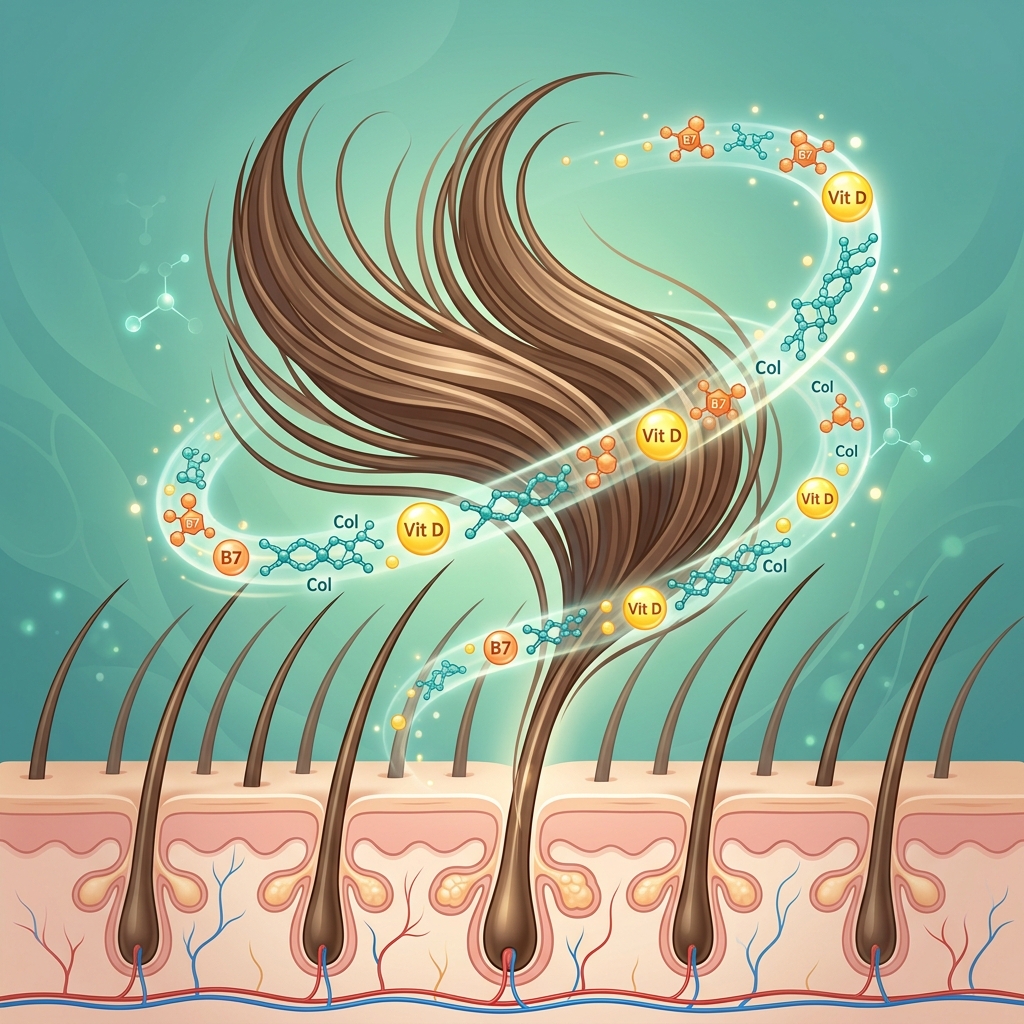
- No Follicular Toxicity: Semaglutide does not poison or directly target hair follicles. The hair loss is a physical condition called Telogen Effluvium (TE).
- Physiological Trigger: Telogen Effluvium is a temporary hair shedding response triggered by sudden metabolic changes, severe caloric deficits, and rapid weight loss.
- Nutrient Shunting: In a severe caloric deficit, the body shunts nutrients away from non-essential functions (like hair follicle division) to protect vital organs, causing a large portion of hair follicles to enter the telogen (resting) phase prematurely.
- Clinical Timeline: Shedding typically starts 2 to 4 months after starting semaglutide (or the onset of rapid weight reduction) and lasts for 3 to 6 months. It is temporary and self-limiting.
- Nutrition Protocol: Target 1.2–1.5g of protein per kg of body weight daily, and maintain key micronutrients: biotin, vitamin D, iron (maintain ferritin levels >50 ng/mL), zinc, and collagen peptides.
- Proactive Action: Implement gradual dose titration, maintain a food diary, practice scalp care, and get routine blood testing checking thyroid (TSH), iron (ferritin), and vitamin D.
Introduction: The Reality of Hair Shedding on GLP-1 Therapy
The introduction of glucagon-like peptide-1 (GLP-1) receptor agonists, such as compounded semaglutide, Wegovy®, and Ozempic®, has transformed the management of obesity and chronic metabolic diseases. By matching the actions of the body's natural GLP-1 hormone, these medications effectively reduce appetite, slow gastric digestion, and curb obsessive thoughts about food (often called "food noise"). However, as semaglutide usage has expanded globally, patients have increasingly reported an unexpected and stressful side effect: sudden, diffuse hair shedding.
For many patients, noticing clumps of hair in the shower or on a hairbrush can cause significant anxiety, sometimes leading them to consider stopping their weight loss therapy entirely. The first and most critical point of reassurance is clinical: semaglutide is not a follicular toxin. The drug does not poison hair roots, alter genetic hair follicles, or cause permanent baldness. Instead, the hair loss is the result of a well-understood physiological response known as Telogen Effluvium (TE). This condition is triggered by the metabolic shock of rapid weight loss and severe caloric restriction, rather than the drug's active chemical structure itself.
Understanding the physiological connection between metabolic changes and hair growth cycles is key to managing and preventing this shedding. This article details the biochemistry of hair growth, explains how rapid weight loss triggers Telogen Effluvium, outlines the timeline of shedding and regrowth, and provides a comprehensive, evidence-based nutritional and clinical protocol to protect your hair while achieving your metabolic goals.
The Physiology of Hair Growth: The Cycle and Metabolic Demands
To understand why weight loss triggers hair shedding, it is helpful to look at how hair grows. Every hair follicle on the human scalp operates as an independent miniature organ, cycling through three distinct physiological phases of growth, regression, and rest:
- The Anagen Phase (Active Growth): This is the active mitotic phase where cells in the hair follicle matrix divide rapidly, building the hair shaft. At any given time, approximately 85% to 90% of scalp hair follicles are in the anagen phase, which typically lasts between 2 and 6 years.
- The Catagen Phase (Transition): This brief, regressive phase lasts about 2 to 3 weeks. Mitotic activity in the matrix ceases, the hair follicle shrinks, and the hair shaft is cut off from its active blood supply. Approximately 1% of hairs are in this transition phase at any time.
- The Telogen Phase (Resting): This resting phase lasts for 2 to 4 months. The hair follicle remains inactive, and the hair shaft (now called a club hair) remains anchored in the follicle. Under normal conditions, about 10% to 15% of scalp hairs are in this resting phase.
At the end of the telogen phase, the follicle enters the Exogen Phase (Shedding), during which the old club hair is shed to make room for a new anagen hair shaft. Normally, humans lose between 50 and 100 hairs per day as part of this natural follicular turnover.
The Metabolic Cost of Active Hair Growth
The hair follicle is one of the most metabolically active tissues in the human body. The cells within the hair follicle matrix divide at an extremely high rate, comparable to the cellular division seen in bone marrow and the lining of the gastrointestinal tract. To support this rapid cell division, the hair follicle requires a constant, uninterrupted supply of energy (adenosine triphosphate, or ATP), oxygen, amino acids (the building blocks of keratin), and essential micronutrients.
When a patient begins taking compounded semaglutide, their appetite decreases, and they enter a caloric deficit. If this deficit is severe, or if weight loss occurs rapidly, the body's homeostatic priority shifts. The brain perceives the sudden drop in energy intake as a period of physical stress or starvation. To survive, the body prioritizes sending energy and nutrients to vital organs (such as the brain, heart, liver, kidneys, and lungs) and shunts resources away from "non-essential" peripheral systems like hair follicles, nails, and outer skin cells. Lacking the necessary energy to sustain rapid mitosis, the cells in the active growth (anagen) phase quickly stop dividing, forcing the hair follicle to enter the resting (telogen) phase prematurely.
What Is Telogen Effluvium? The Metabolic Shunting Mechanism
Telogen Effluvium (TE) is a form of temporary, diffuse hair shedding that occurs when a physical, psychological, or metabolic stressor forces a large cohort of active hair follicles to exit the growth phase and enter the resting phase at the same time. Rather than the typical 10% of hairs resting, Telogen Effluvium can cause 30% or more of scalp follicles to shift into the resting phase simultaneously.
The biochemistry of this shift involves metabolic shunting. During a severe caloric deficit, the body conserves energy. Mitosis in the hair follicle matrix is a highly energy-demanding process. By halting cellular division in the hair roots, the body saves valuable amino acids and ATP for critical organ function. The hair follicle matrix ceases division, and the follicle progresses through the catagen phase and remains in the telogen phase for 2 to 4 months.
Because these resting hairs remain anchored in the scalp for several months, the patient does not notice immediate shedding. However, once the follicles transition back to the active growth phase, the newly forming hair shafts push the old resting club hairs out of the follicles, resulting in significant, diffuse shedding. This delay between the metabolic trigger (rapid weight loss) and the actual shedding is a hallmark of Telogen Effluvium.
It is clinically important to differentiate between temporary, weight-loss-induced shedding (Telogen Effluvium) and progressive, genetic hair loss (Androgenetic Alopecia):
| Feature | Telogen Effluvium (TE) | Androgenetic Alopecia (AGA) |
|---|---|---|
| Primary Cause | Metabolic shock, rapid weight loss, severe caloric deficits | Genetic sensitivity to Dihydrotestosterone (DHT) |
| Shedding Pattern | Diffuse thinning across the entire scalp | Patterned thinning (receding hairline, thinning crown) |
| Onset & Timeline | Sudden, starting 2–4 months after the trigger | Gradual, progressing slowly over years |
| Reversibility | Fully reversible; self-limiting within 6–12 months | Progressive; requires active treatment to stop |
| Follicular Health | Follicles remain healthy but rest temporarily | Follicles shrink (miniaturize) permanently |
The Timeline: From Metabolic Trigger to Regrowth
Understanding the timeline of Telogen Effluvium is crucial for managing patient expectations and reducing anxiety. Because of the delay inherent in the hair growth cycle, the physical shedding of hair does not align with the immediate start of semaglutide or the weeks of fastest weight loss. The process follows a predictable, self-limiting clinical course:
- Metabolic Shock (Week 0–4): The patient starts semaglutide, experiences rapid appetite suppression, and enters a significant caloric deficit. Weight loss begins quickly, and the body shunts nutrients away from hair follicles. A large portion of follicles exit the growth phase.
- Follicular Latency (Month 1–2): The affected hair follicles remain in the telogen (resting) phase. The hair shafts are not yet falling out, and the patient does not notice any change in hair thickness.
- Onset of Shedding (Month 2–4): The resting hairs begin to exit the follicles. Diffuse shedding begins, and patients notice more hair than usual falling out in the shower, on hairbrushes, or on pillows. The hair thinness is diffuse, rather than concentrated in specific bald spots.
- Active Shedding Phase (Month 3–6): This is the peak shedding period, typically lasting 3 to 6 months. During this time, patients may shed 150 to 300 hairs per day. While alarming, it is important to remember that this process is self-limiting and will resolve on its own.
- Regrowth Initiation (Month 6+): As the patient's weight stabilizes, their metabolic rate adjusts to the lower calorie intake, and their dose is maintained, the follicles exit the resting phase and enter the active growth phase again. Fine, new hairs (often visible as short, upright baby hairs along the hairline) begin to emerge.
- Density Recovery (Month 12–18): The new hairs grow at a rate of approximately half an inch per month. Over the course of a year, the original hair density is slowly restored, though it will take longer for the new growth to reach the length of the surrounding hair.
Safe Weight Management Protocol at $79/Month — Flat Rate
Telemetry, clinical oversight, and compounded semaglutide from state-licensed 503A pharmacies. Get evaluated by a licensed U.S. medical provider online and receive your medication shipped directly to your door.
Start Medical AssessmentThe Clinical Nutrition Protocol to Mitigate Hair Loss
While Telogen Effluvium is a self-limiting condition, its severity can be reduced, and the recovery process accelerated, through targeted nutritional support. When caloric intake is reduced on semaglutide, the diet must be highly nutrient-dense to protect metabolically active tissues like hair follicles. For additional diet tips, refer to our guide on the ideal semaglutide diet plan. The following clinical nutrition protocol is designed to support the metabolic demands of hair growth:
1. Protein Intake: The Keratin Foundation
Keratin is a fibrous structural protein that makes up 85% to 90% of the hair shaft. Keratin is rich in sulfur-containing amino acids, particularly cysteine, as well as proline, glycine, and arginine. During caloric restriction, if protein intake is insufficient, the body will break down hair proteins to support essential metabolic functions.
To prevent this, patients should consume 1.2 to 1.5 grams of protein per kilogram of body weight daily (approx. 96 to 120 grams of protein for an 80 kg/176 lb individual). Focus on lean, easily digestible protein sources such as skinless chicken breast, wild-caught white fish, egg whites, low-fat Greek yogurt, tofu, and high-quality grass-fed whey isolate or clean plant-based protein powders.
2. Iron and Ferritin: Supporting Root Mitosis
Iron acts as a key cofactor for ribonucleotide reductase, the rate-limiting enzyme in DNA synthesis, which is crucial for the rapidly dividing cells of the hair follicle matrix. Ferritin is the protein that stores iron in the body's cells. While standard reference ranges for serum ferritin in women may start as low as 15 ng/mL, optimal hair follicle function requires maintaining ferritin levels above 50 ng/mL, and ideally closer to 70–80 ng/mL.
If blood tests show that ferritin is below 50 ng/mL, daily supplementation with iron bisglycinate (36 to 54 mg of elemental iron) is recommended. Iron bisglycinate is generally gentler on the GI tract than ferrous sulfate. For best absorption, take iron supplements with 250 mg of Vitamin C on an empty stomach, and avoid taking them with calcium or caffeine.
3. Vitamin D3: Regulating the Follicle Cycle
Vitamin D plays an important role in modulating the growth and differentiation of keratinocytes. The hair follicle receptor for Vitamin D is expressed in both the outer root sheath and the hair matrix. Deficiencies in Vitamin D are closely linked to diffuse hair shedding and delayed regrowth.
Target a serum 25-hydroxyvitamin D level of above 40 ng/mL. Daily supplementation with 2,000 to 5,000 IU of Vitamin D3 (cholecalciferol), paired with Vitamin K2 (menaquinone-7) to help guide calcium to the bones, is often needed to maintain these levels during weight loss.
4. Zinc: Essential for Cell Division
Zinc is a cofactor for more than 300 enzymes and plays a structural role in nucleic acid and protein synthesis. A zinc deficiency can disrupt cell division in the hair follicle, weaken the hair shaft, and cause the follicle to regress into the resting phase prematurely.
Patients should aim for 11 to 15 mg of elemental zinc daily. Zinc picolinate is an easily absorbed form. To avoid copper deficiency, zinc supplementation should be balanced with 1–2 mg of copper if taken for more than three months.
5. Biotin (Vitamin B7): Improving Keratin Structure
Biotin serves as an essential coenzyme for carboxylase enzymes involved in fatty acid synthesis and amino acid metabolism. While true biotin deficiency is rare, supplemental biotin (2,500 to 5,000 mcg daily) supports the lipid barrier and protein structure of keratin, helping to improve hair thickness and prevent brittleness during active shedding.
6. Hydrolyzed Collagen Peptides: Sourcing Key Amino Acids
Hydrolyzed collagen peptides provide a rich source of proline, glycine, and hydroxyproline—the raw materials the body uses to synthesize keratin and support the dermal matrix. Incorporating 10 to 20 grams of collagen peptides daily into a morning beverage or smoothie provides the amino acids needed to strengthen the hair shaft and support the scalp's dermal tissue.
Proactive Prevention and Diagnostic Strategies
In addition to dietary support, patients can take several proactive steps to minimize the severity of Telogen Effluvium and ensure that hair shedding is not worsened by other underlying medical conditions:
Gradual Dose Titration
The primary trigger for Telogen Effluvium is the rate of weight loss and the severity of the caloric deficit, rather than the total amount of weight lost. To reduce the risk of hair shedding, work with your healthcare provider to titrate your semaglutide dose gradually. Avoid the temptation to escalate the dose quickly. Staying on the lowest effective dose (such as 0.25 mg or 0.5 mg) as long as weight loss is steady helps prevent the extreme caloric deficits that trigger metabolic shunting.
Keeping a Food and Protein Diary
Because GLP-1 medications reduce the brain's "food noise," patients can easily underestimate how little they are eating. Tracking daily intake in a digital food diary helps ensure that calories do not fall below safe minimum thresholds (1,200 kcal/day for women, 1,500 kcal/day for men) and helps confirm that protein and hydration targets are being met consistently.
Scalp Microbiome and Mechanical Care
During active shedding, protect the remaining hair and support the scalp environment by practicing gentle hair care:
- Use a mild, sulfate-free shampoo to clean the scalp without removing essential lipids.
- Avoid harsh chemical treatments, bleaching, perms, or heat styling tools that can damage the hair shaft.
- Avoid tight hairstyles (such as high ponytails or tight braids) that put physical tension on the hair root, which can cause traction alopecia.
- Massage the scalp gently during washing to help promote local blood circulation.
Routine Diagnostic Blood Panels
If you experience persistent or severe diffuse hair shedding, get a comprehensive blood panel to check for other potential causes of hair loss. Discuss the following tests with your provider:
- TSH (Thyroid Stimulating Hormone): Both hypothyroidism and hyperthyroidism are common causes of diffuse hair shedding and should be ruled out.
- Serum Ferritin: Check your iron stores, aiming for a target of >50 ng/mL.
- 25-hydroxyvitamin D: Assess your Vitamin D levels, aiming for a target of >40 ng/mL.
- CBC (Complete Blood Count): Screen for systemic anemia.
For more details on clinical safety and managing side effects, see our analysis on whether compounded semaglutide is safe, as well as our pricing guide for finding the cheapest semaglutide online in 2026.
Frequently Asked Questions
No. Semaglutide is a GLP-1 receptor agonist that acts on appetite and metabolic pathways; it has no follicular toxicity and does not target or poison hair follicles. The hair shedding experienced by some patients is a temporary physiological condition called Telogen Effluvium (TE), which is triggered by rapid weight loss and severe caloric deficits, not the drug itself.
Telogen Effluvium is a form of temporary hair shedding that occurs when a physical or metabolic stressor forces a large portion of hair follicles to enter the telogen (resting) phase of the growth cycle prematurely. During rapid weight reduction or extreme caloric restriction, the body prioritizes survival by shunting nutrients and energy away from non-essential functions, like cellular division in hair follicles, to protect vital organs. This results in diffuse shedding a few months later.
Shedding typically begins 2 to 4 months after initiating semaglutide therapy or after the onset of rapid weight reduction. The active shedding phase generally lasts for 3 to 6 months. Because Telogen Effluvium is self-limiting, the shedding will stop, and hair will begin to regrow once the body adjusts to the new weight and nutrition intake.
To preserve muscle tissue and support hair follicle health, clinical nutrition protocols recommend consuming 1.2 to 1.5 grams of protein per kilogram of body weight daily. For a person weighing 80 kg (approx. 176 lbs), this equates to 96 to 120 grams of protein per day. Keratin, the primary protein in hair, requires a steady supply of amino acids to maintain follicular division.
Key micronutrients to monitor include Biotin (Vitamin B7) for keratin synthesis, Vitamin D to modulate follicle cycling, Iron (maintaining ferritin levels above 50 ng/mL), Zinc for cellular division, and collagen peptides to supply essential amino acids. Normal reference ranges for ferritin are often too low for optimal hair growth, so target levels above 50 ng/mL.
You should consult your healthcare provider before making any changes. Because Telogen Effluvium is a temporary reaction to rapid weight loss and metabolic change rather than a direct toxic reaction to semaglutide, stopping the medication is usually not required. Focusing on gradual dose titration, tracking protein, and ensuring adequate micronutrient intake will allow the hair to regrow while continuing therapy.
Start Compounded Semaglutide at $79/Month — All-Inclusive
Complete your 5-minute online medical assessment, consult with a licensed provider within 24 hours, and receive compounded semaglutide from a state-licensed 503A pharmacy. Enjoy flat-rate pricing and free expedited shipping.
Get Started TodayClinical References & Sources
- Wilding, J. P. H., Bateman, A. H., et al. (2021). Once-weekly semaglutide in adults with overweight or obesity (STEP 1). New England Journal of Medicine, 384(11), 989-1002. ClinicalTrials.gov (NCT03548935)
- Almohanna, H. M., et al. (2019). The Role of Vitamins and Minerals in Hair Loss: A Review. Dermatology and Therapy, 9(1), 51-70. PubMed (PMC6380979)
- Shrivastava, S. B. (2009). Diffuse alopecia: An overview. Indian Journal of Dermatology, Venereology and Leprology, 75(1), 20-27. LWW Journals
- Harrison, S., & Bergfeld, W. (2002). Diffuse hair shedding. Clinical and Experimental Dermatology, 27(5), 389-395. Wiley Online Library
- Malkud, S. (2015). Telogen Effluvium: A Review. Journal of Clinical and Diagnostic Research, 9(9), WE01-WE03. PubMed (PMC4606321)