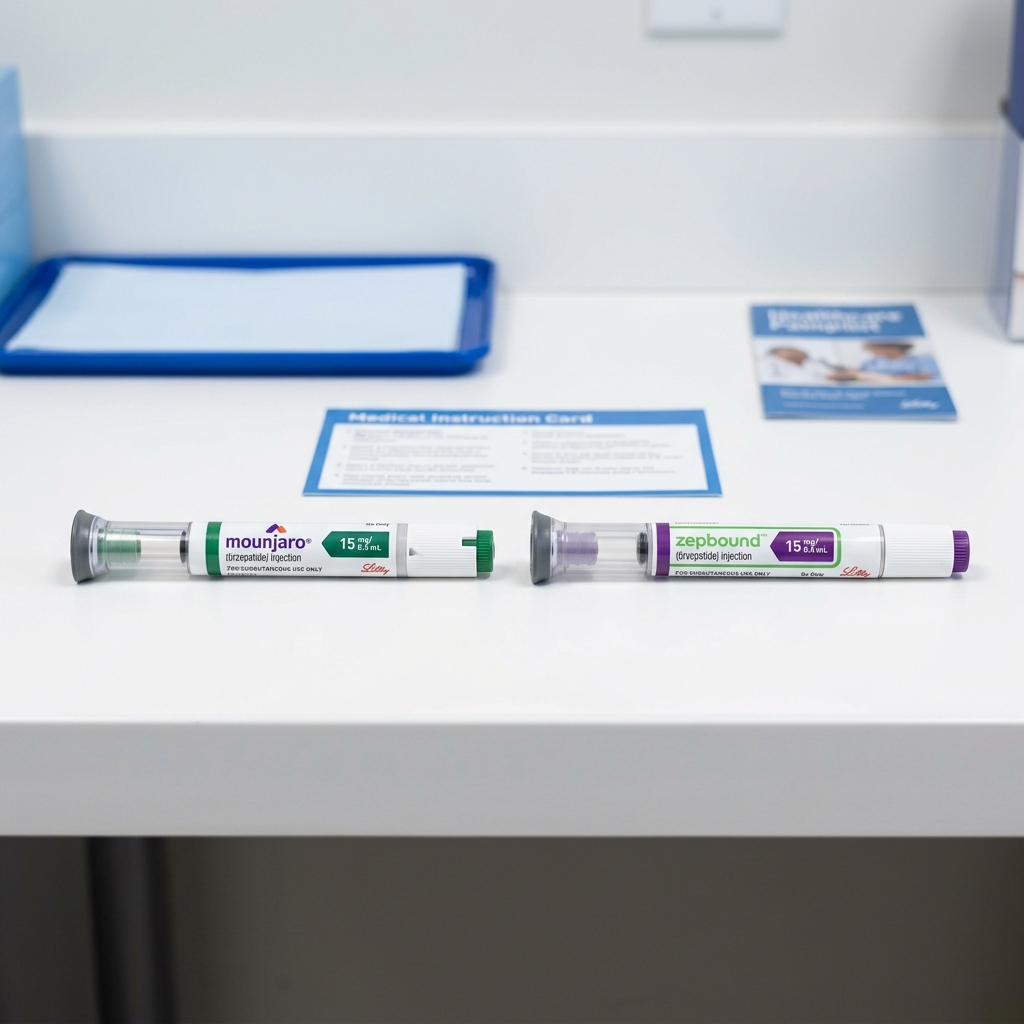
- Identical Active Molecule: Both Zepbound and Mounjaro contain tirzepatide, manufactured by Eli Lilly, using the exact same dosing strengths (2.5 mg to 15 mg).
- Different FDA Indications: Mounjaro is FDA-approved exclusively for type 2 diabetes; Zepbound is FDA-approved for chronic weight management. Zepbound for Obesity
- Robust Clinical Efficacy: Trial data shows blood sugar reduction and secondary weight loss in the diabetic SURPASS program vs. up to 20.9% primary weight reduction in the obesity-focused SURMOUNT program.
- Insurance and Prior Authorization (PA) Discrepancies: Insurance covers Mounjaro broadly under diabetes benefits, whereas Zepbound requires anti-obesity coverage, which is frequently excluded.
- Identical Pen Devices: Both medications are delivered using identical grey single-dose auto-injector pens with color-coded caps representing dosing strengths.
- Compounded Alternative: Compounded tirzepatide through telehealth platforms like Losing Weight RX offers a flat-rate alternative of $129/month with no insurance needed. Value Leader
Is There Actually a Biological Difference Between Zepbound and Mounjaro?
If you have been looking into advanced medical options for metabolic health or weight loss, you have likely come across two of the most talked-about medications on the market: Zepbound and Mounjaro. Both are manufactured by the pharmaceutical giant Eli Lilly and Company. Both contain the exact same active pharmaceutical ingredient: tirzepatide. And both are injected once weekly using identical pen designs and equivalent doses.
Yet, they are marketed under two completely different names, packaged in different boxes, and subjected to entirely different pharmacy benefits and insurance coverages. To the consumer, it can feel like a corporate shell game. If the molecule inside the pen is exactly the same, why do they exist as separate brands? And more importantly, which one should you choose for your health goals?
The short answer is that chemically, Zepbound and Mounjaro are identical. However, the regulatory pathways, clinical target populations, and insurance realities separating them are vast. Understanding these key differences is essential to navigating your treatment options, obtaining a prescription, and avoiding thousands of dollars in unnecessary out-of-pocket costs.
The Science of Tirzepatide: How the Molecule Works
To understand Zepbound and Mounjaro, you first have to understand the active molecule, tirzepatide. Tirzepatide represents a major evolutionary leap forward in the treatment of obesity and type 2 diabetes, building on the success of single-receptor agonists like semaglutide (learn more in our complete guide to semaglutide). For more context on these differences, you can read our detailed guide on Tirzepatide vs. Semaglutide.
While semaglutide targets a single hormone receptor, tirzepatide is a dual GIP and GLP-1 receptor agonist. This dual-agonist mechanism targets two separate gut-derived hormones that are naturally released after eating:
- GLP-1 (Glucagon-Like Peptide-1): This hormone acts on the brain to suppress appetite, slows down the rate of gastric emptying (which keeps you feeling full longer), and signals the pancreas to release insulin in response to glucose levels.
- GIP (Glucose-Dependent Insulinotropic Polypeptide): GIP works synergistically with GLP-1. In the brain, GIP receptors help reduce food intake and lessen the nausea frequently associated with GLP-1 activation. In fat tissue, GIP improves lipid buffering and insulin sensitivity, helping the body burn energy more efficiently.
By mimicking both hormones, tirzepatide attacks metabolic dysfunction and excess weight from multiple angles simultaneously. In clinical practice, this dual-mechanism approach has shown unparalleled efficacy, helping patients achieve average weight reductions that were previously only seen through invasive procedures like bariatric surgery.
Dosing and Titration Schedules
Because the underlying liquid is identical, both Zepbound and Mounjaro follow the exact same weekly dosing structure. Patients start on a low initiation dose to allow their gastrointestinal systems to adjust, followed by monthly titrations depending on tolerability and clinical response. The dosing strengths include:
- Initiation Dose: 2.5 mg once weekly for 4 weeks. (This is primarily a starter dose and not intended for glycemic control or major weight maintenance).
- Titration Doses: 5.0 mg, 7.5 mg, 10.0 mg, 12.5 mg, and 15.0 mg once weekly.
Increments are adjusted in 2.5 mg steps. The maximum dose for both Zepbound and Mounjaro is 15.0 mg once weekly. Regardless of which brand name is written on your prescription pad, your titration and maintenance schedules will be the same.
FDA Approvals: Diabetes vs. Weight Management
The primary reason Eli Lilly created two separate brands for tirzepatide comes down to the Food and Drug Administration (FDA) approval process. In the United States, drug manufacturers must seek separate approvals for different clinical indications, even if they are using the exact same active ingredient. This separation prevents off-label marketing and aligns products with distinct medical specialties.
FDA Indication: Type 2 Diabetes
Mounjaro is FDA-approved strictly as an adjunct to diet and exercise to improve glycemic control in adults with type 2 diabetes mellitus. Clinical guidelines mandate its use for managing blood sugar levels and reducing long-term cardiovascular risks in patients with diabetes.
FDA Indication: Chronic Weight Management
Zepbound is FDA-approved for chronic weight management in adults with a body mass index (BMI) of 30 kg/m² or greater (obesity), or a BMI of 27 kg/m² or greater (overweight) in the presence of at least one weight-related comorbid condition (such as hypertension, dyslipidemia, or obstructive sleep apnea).
Because these indications are distinct, healthcare providers must diagnose a patient with type 2 diabetes to write an on-label prescription for Mounjaro. If a patient does not have type 2 diabetes but struggles with obesity, the provider must write the prescription for Zepbound. While providers can legally prescribe Mounjaro off-label for weight loss, doing so has major negative consequences for insurance coverage.
SURPASS vs. SURMOUNT: What the Clinical Trials Proved
To secure these separate FDA approvals, Eli Lilly had to conduct two massive, independent clinical trial programs. These programs evaluated the safety and efficacy of tirzepatide in completely different patient populations, highlighting the dual benefits of the molecule.
The SURPASS Trials (Type 2 Diabetes)
The SURPASS program focused on patients with established type 2 diabetes. The trials studied how weekly tirzepatide compared to placebo, semaglutide 1 mg, and daily basal insulin. The results were outstanding:
- HbA1c Reduction: In the SURPASS-1 trial, up to 92% of patients taking the 15 mg dose achieved an HbA1c (average blood sugar marker) of under 5.7%, which is within the normal non-diabetic range.
- Head-to-Head vs. Semaglutide: The SURPASS-2 trial compared tirzepatide (5 mg, 10 mg, and 15 mg) directly to semaglutide 1 mg (Ozempic). Tirzepatide demonstrated superior reductions in both HbA1c levels and body weight at all three doses compared to semaglutide.
- Secondary Weight Loss: Although weight loss was a secondary endpoint in SURPASS, diabetic patients lost an average of 15 to 25 pounds, demonstrating the powerful weight-reducing properties of GIP/GLP-1 receptor agonists.
The SURMOUNT Trials (Obesity and Weight Management)
The SURMOUNT trials evaluated tirzepatide specifically for chronic weight management in patients who did not have type 2 diabetes. The primary goal was to measure maximum weight loss percentage:
- Landmark Weight Reduction: The SURMOUNT-1 trial enrolled 2,539 adults with obesity or overweight. Over a 72-week period, patients taking the maximum 15 mg dose of tirzepatide achieved an average body weight reduction of up to 20.9% (an average loss of 52 lbs / 23.6 kg).
- High Responders: An astonishing 91% of participants on the 15 mg dose lost at least 5% of their body weight, and over 50% of patients on the 10 mg and 15 mg doses achieved a weight loss of 20% or greater.
- Metabolic Improvements: Participants also experienced significant, sustained improvements in blood pressure, fasting insulin, cholesterol levels, and waist circumference, demonstrating systemic metabolic rejuvenation.
The Core Difference in Trial Design: The SURPASS trials established tirzepatide's safety and glycemic efficacy in patients with type 2 diabetes, where weight loss was tracked as a secondary benefit. The SURMOUNT trials isolated the weight-loss efficacy of tirzepatide in patients without diabetes, demonstrating a maximum average weight reduction of up to 20.9%. Patients with diabetes typically lose weight at a slightly slower rate than patients without diabetes, which is why having distinct trials was clinically necessary.
Zepbound vs. Mounjaro: Characteristics Grid & Table
To help visualize how Zepbound and Mounjaro stack up against each other, here is a detailed side-by-side comparison of their branding, clinical features, and availability in 2026.
| Factor | Zepbound® | Mounjaro® |
|---|---|---|
| Active Ingredient | Tirzepatide | Tirzepatide |
| Primary FDA Indication | Chronic Weight Management | Type 2 Diabetes Mellitus |
| Manufacturer | Eli Lilly and Company | Eli Lilly and Company |
| Dosing Strengths | 2.5 mg to 15.0 mg once weekly | 2.5 mg to 15.0 mg once weekly |
| Maximum Weekly Dose | 15 mg/week | 15 mg/week |
| Key Clinical Trials | SURMOUNT Trial Program | SURPASS Trial Program |
| Trial Weight Loss (Max) | Up to 20.9% (SURMOUNT-1) | ~15.0% (diabetic population) |
| Dose Delivery Device | Single-dose grey auto-injector | Single-dose grey auto-injector |
| Insurance Coverage | Limited (anti-obesity exclusion) | Broad (standard diabetes benefit) |
| Medicare Coverage | No (statutory weight loss ban) | Yes (under Part D for diabetes) |
| Average Retail Price | ~$1,060 per month | ~$1,070 per month |
Primary FDA Indication
Key Clinical Trials
Trial Weight Loss (Max)
Insurance Coverage
Medicare Coverage
The Real Battle: Insurance Coverage & Prior Authorizations
While the clinical data is highly compelling, the practical reality of accessing tirzepatide is defined by insurance coverage. This is where Zepbound and Mounjaro diverge completely, and it is the source of significant frustration for patients and prescribing doctors.
Mounjaro Insurance Guidelines
Because type 2 diabetes is a chronic cardiovascular and metabolic health emergency, treatments for it are classified as essential health benefits. Consequently, almost all commercial insurance policies, Medicare Part D, and Medicaid programs cover Mounjaro. If you have type 2 diabetes, obtaining insurance approval is typically straightforward, with copays ranging between $25 and $150 per month.
However, insurers are highly protective of Mounjaro. To prevent off-label prescribing for weight loss, most plans require a strict Prior Authorization (PA). The insurer will demand to see:
- Recent lab tests showing an elevated HbA1c level.
- A formal ICD-10 diagnosis code for type 2 diabetes.
- Proof that you have tried and failed first-line diabetic treatments like metformin.
If your provider submits a PA for Mounjaro without a type 2 diabetes diagnosis, the insurer will deny the claim in nearly all cases.
Zepbound Insurance Guidelines
Zepbound is classified as an "anti-obesity medication" (AOM). Historically, insurers have viewed obesity as a lifestyle issue rather than a chronic disease, allowing employers to opt-out of anti-obesity medication coverage to save on premium costs. The statistics are challenging:
- Only about 30% to 50% of commercial plans currently cover anti-obesity drugs like Zepbound.
- The Medicare statutory ban: By federal law passed in 2003, Medicare Part D is explicitly barred from covering medications used for weight loss, leaving seniors with obesity forced to pay full retail price.
- Even when Zepbound is covered, PAs are strictly audited, requiring BMI logs, proof of enrollment in a structured behavioral modification program, and documentation of failed lifestyle changes.
If your insurance plan does not cover weight loss drugs, a prescription for Zepbound will result in a retail pharmacy bill of over $1,000 per month, even with Eli Lilly's manufacturer savings cards. For many, this price barrier makes brand-name Zepbound completely inaccessible.
Tirzepatide for $129/Month — Flat Rate, Shipped Cold
Bypass the prior authorization headaches. Losing Weight RX connects you with U.S. licensed providers who can prescribe compounded tirzepatide, shipped directly to your door for one flat, affordable rate.
Get Started OnlineInjection Pens: What Do they Look Like?
Because both products contain the exact same formulation developed by Eli Lilly, they are packaged in the exact same single-dose auto-injector pen device. If you put a Zepbound pen and a Mounjaro pen of the same dose side by side, they look identical.
The device features a grey body with a clear window that displays the medication, and a color-coded cap at the injection tip indicating the dose strength. The operation is designed to be as simple and painless as possible:
- No Dialing Needed: Unlike insulin pens or Ozempic pens, which allow you to select your dose via a rotating dial, Lilly's tirzepatide pens are prefilled with a single, non-adjustable dose. You inject the entire contents of the pen at once.
- Hidden Needle: The needle is completely recessed inside the pen body and is never visible. Once you place the pen flat against your skin (typically on your abdomen, thigh, or upper arm), you unlock the pen and press the top button.
- Automatic Injection: An internal spring automatically inserts the needle, delivers the dose, and retracts the needle into the plastic housing. Dual clicking sounds indicate when the injection has started and when it has finished.
While this single-dose design is incredibly user-friendly and reduces the risk of dosing errors, it does have a significant drawback: it offers no dosage flexibility. If you experience severe side effects on a 7.5 mg dose and wish to drop back to 5.0 mg, you cannot adjust the pen. Your provider must write a brand-new prescription for the 5.0 mg strength box, and you must purchase a completely new set of pens. This is a primary reason why many patients seek out customizable compounded alternatives, which allow you to adjust your dose at home under medical supervision using a standard syringe.
Pricing Comparison: Retail Costs vs. Alternatives
How much do these medications cost without insurance? If you are paying out of pocket, the pricing structures for brand-name Zepbound and Mounjaro are nearly identical, and they are prohibitively expensive for the average consumer.
Losing Weight RX
- Identical active tirzepatide molecule
- No insurance required
- Custom dosing flexibility
- FSA/HSA cards accepted
- Free expedited cold shipping
- No contracts, cancel anytime
Zepbound / Mounjaro
- FDA-approved brand product
- Prefilled pen device
- Subject to pharmacy shortages
- Fixed dose increments only
- Requires strict prior authorization
- Eli Lilly savings card available
If you are paying out of pocket for brand-name Zepbound or Mounjaro, your annual expense will exceed $12,700. For patients looking to manage their weight over the long term, this is a significant financial commitment. In contrast, choosing compounded tirzepatide through Losing Weight RX reduces your annual cost to $1,548. This represents a yearly savings of up to $11,292, making clinical-grade weight care sustainable for those without insurance coverage.
Compounded Tirzepatide: The Affordable Alternative
Faced with high out-of-pocket costs and ongoing manufacturing shortages of brand-name pens, many patients have turned to compounded tirzepatide. If you are unfamiliar with the safety and legality of compounding, it is helpful to look at our guide on Cheapest Tirzepatide Online 2026.
What is Compounded Tirzepatide?
Under Section 503A of the Federal Food, Drug, and Cosmetic Act, state-licensed compounding pharmacies are legally permitted to prepare custom formulations of medications when a drug is listed on the FDA's active drug shortage list. Because Lilly's tirzepatide has faced consistent supply issues due to unprecedented demand, compounding pharmacies have been authorized to formulate compounded tirzepatide using the same active pharmaceutical ingredient.
Compounded medications do not undergo individual pre-market FDA review for safety and efficacy. However, they are prescribed by licensed medical providers and prepared by credentialed compounding pharmacies that must adhere to strict state and federal quality control guidelines.
Why Choose Losing Weight RX Over Other Platforms?
As the demand for compounded peptides has grown, many telehealth start-ups have launched weight loss programs. Unfortunately, patient reviews on platforms like Reddit and Trustpilot highlight common problems with these services:
- Subscription Traps: Many platforms advertise a low introductory price (like $99), only to hide the fact that they charge an additional $79–$99 monthly membership fee just to access their service, raising the real cost significantly.
- Escalating Prices: Other companies charge a low rate for starter doses (2.5 mg) but increase the price by hundreds of dollars as your dose increases, creating a financial penalty for making progress.
- Long Shipping Delays: Patients frequently complain about waiting weeks for their order to arrive, disrupting their weekly injection schedule.
- Hidden Commitments: Some providers lock patients into 3-month or 6-month contracts with high cancellation fees.
Losing Weight RX was built to solve these issues. We offer a transparent, patient-first program designed for long-term success:
- Flat-Rate Pricing: Compounded tirzepatide is $129/month flat. No hidden membership fees, no consultation fees, and no price increases at higher doses.
- No Contracts: You pay month-to-month and can pause or cancel your program at any time without penalty.
- Fast Medical Reviews: Our network of U.S. licensed providers reviews your medical assessment within 24 hours of submission.
- Expedited Cold-Chain Shipping: We process and ship your medication in insulated, temperature-controlled packaging via expedited delivery at no extra cost, ensuring the peptide remains stable and effective.
- FSA/HSA Eligible: We accept Flexible Spending Account (FSA) and Health Savings Account (HSA) cards, allowing you to use pre-tax dollars for your treatment.
Decision Guide: Which Version of Tirzepatide is Best for You?
Since the molecule inside Zepbound, Mounjaro, and compounded tirzepatide is chemically identical, your decision should be based on your diagnosis, insurance coverage, and budget. Here is a clinical framework to help guide your choice:
1. Choose Mounjaro If:
- You have a documented diagnosis of Type 2 Diabetes Mellitus.
- Your health insurance plan covers Mounjaro under its standard diabetes formulary with a reasonable copay.
- Your primary health goal is glycemic control and managing diabetes-related cardiovascular risk.
2. Choose Zepbound If:
- You do not have diabetes, but you meet the BMI criteria for obesity or overweight with comorbidities.
- Your employer's insurance plan includes anti-obesity medication coverage and has approved your prior authorization.
- You qualify for and can utilize Eli Lilly's co-pay assistance cards to bring your monthly out-of-pocket cost down to a manageable range.
3. Choose Compounded Tirzepatide (Losing Weight RX) If:
- You do not have type 2 diabetes, and your insurance plan excludes coverage for weight loss medications.
- You want to avoid paying over $1,000 per month out-of-pocket for brand-name drugs.
- You are a senior on Medicare facing the statutory ban on weight-loss coverage.
- You want dosage flexibility to manage side effects, rather than being locked into fixed-dose pens.
- You want to avoid local pharmacy shortages and secure a reliable monthly supply shipped directly to your home.
Frequently Asked Questions
Yes, Zepbound and Mounjaro contain the exact same active pharmaceutical ingredient, tirzepatide, manufactured by Eli Lilly. They are chemically identical, utilize the same dosing concentrations, and use the identical single-dose auto-injector pen. The primary differences lie in their FDA-approved clinical indications (Zepbound for obesity, Mounjaro for type 2 diabetes) and how insurance covers them.
Yes. A licensed provider can legally prescribe Mounjaro off-label for chronic weight management if they believe it is clinically appropriate for the patient. However, insurance plans will almost never cover Mounjaro for off-label weight loss if the patient does not have a documented diagnosis of type 2 diabetes, leading to high out-of-pocket costs.
Mounjaro is classified under type 2 diabetes treatments, which are standard, mandatory pharmacy benefits on nearly all health insurance plans. Zepbound is classified under anti-obesity medications (AOMs), which are voluntary employer opt-ins that many commercial plans exclude. Additionally, Medicare is statutorily prohibited from covering medications specifically indicated for weight loss, including Zepbound.
A prior authorization is a requirement by insurance plans where your provider must submit clinical documentation (like lab results, diagnosis codes, or BMI history) proving the drug is medically necessary. For Mounjaro, the PA usually requires a type 2 diabetes diagnosis. For Zepbound, the PA requires a BMI of 30+ (or 27+ with comorbidities) and proof that your plan includes weight-loss benefits.
Yes. If insurance denies coverage and the $1,000+ brand-name retail price is too high, patients can choose compounded tirzepatide from telehealth platforms like Losing Weight RX. Compounded tirzepatide contains the identical active molecule at a flat rate of $129/month, with no insurance required, no membership fees, and free expedited cold-chain shipping.
Compounded tirzepatide through Losing Weight RX costs a flat rate of $129 per month. Unlike other telehealth platforms, there are no hidden membership fees, no consultation fees, and no multi-month contract lock-ins. Shipping is free, FSA and HSA cards are accepted, and U.S. licensed providers complete your medical review within 24 hours.
Access Tirzepatide for $129/Month — No Insurance Needed
Avoid expensive brand-name markups and prior authorization denials. Complete a simple 5-minute online medical assessment and let our U.S. licensed providers customize your weight care plan.
Start Your AssessmentClinical References & Sources
- Jastreboff, A. M., Aronne, L. J., Ahmad, N. N., Wharton, S., Connery, L., Alves, B., ... & SURMOUNT-1 Investigators. (2022). Tirzepatide once weekly for the treatment of obesity. New England Journal of Medicine, 387(3), 205-216. PubMed Link
- Frías, J. P., Davies, M. J., Rosenstock, J., Pérez Manghi, F. C., Fernández Landó, L., Bergman, B. K., ... & SURPASS-2 Investigators. (2021). Tirzepatide versus semaglutide once weekly in patients with type 2 diabetes. New England Journal of Medicine, 385(6), 503-515. PubMed Link
- Rosenstock, J., Wysham, C., Frías, J. P., Kaneko, S., Lando, L. F., Sanz, L. H., ... & SURPASS-1 Investigators. (2021). Efficacy and safety of a novel dual GIP and GLP-1 receptor agonist, tirzepatide, in patients with type 2 diabetes (SURPASS-1): a double-blind, randomised, phase 3 trial. The Lancet, 398(10295), 143-155. PubMed Link