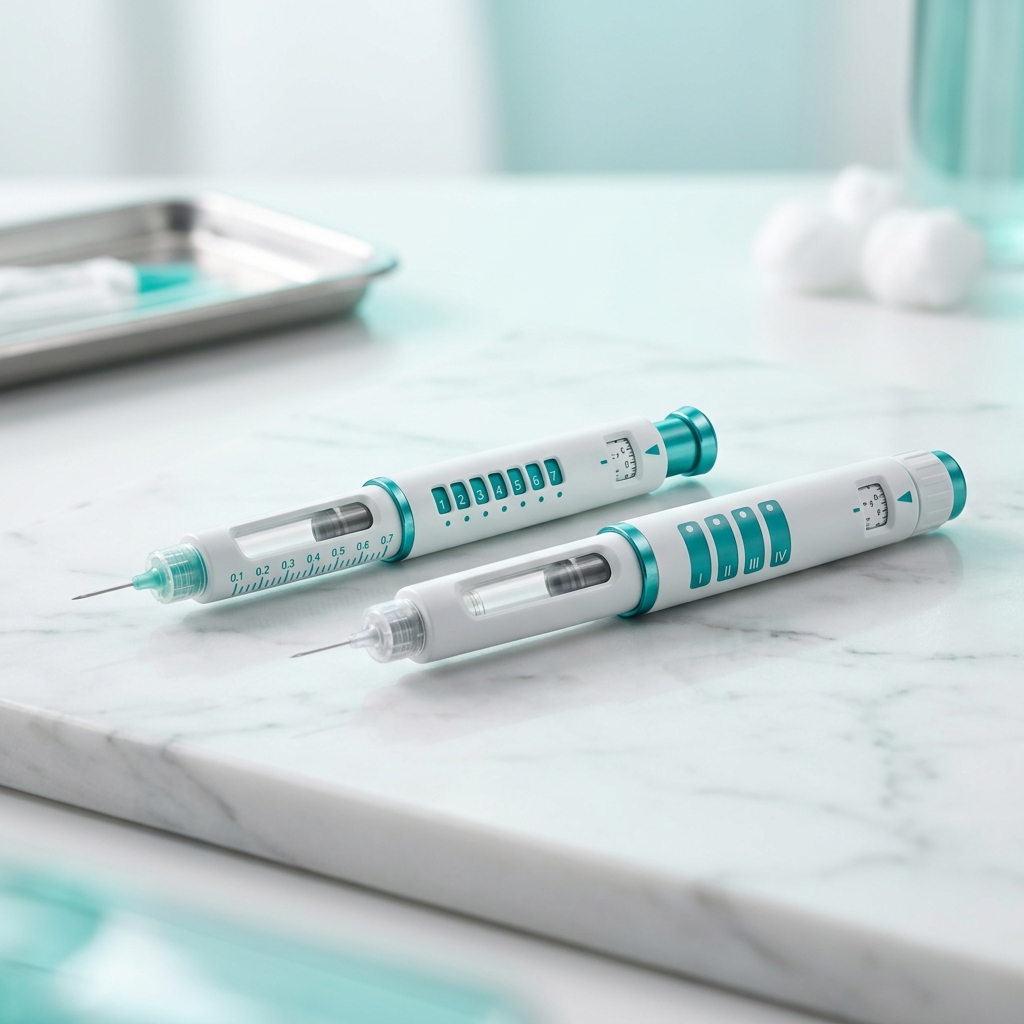
- Injection frequency: Saxenda (liraglutide) requires 365 daily injections per year. Semaglutide (Wegovy/compounded) requires just 52 weekly injections — an 86% reduction in needle sticks.
- Weight loss efficacy: The STEP 1 trial showed 14.9% mean body weight loss with weekly semaglutide 2.4 mg vs. roughly 8% with daily liraglutide 3.0 mg in the SCALE trial.
- Pharmacokinetic advantage: Semaglutide's 168-hour half-life (vs. liraglutide's 13-hour half-life) enables once-weekly dosing with stable, sustained GLP-1 receptor activation.
- Side effect profiles: Both medications share GI side effects (nausea, vomiting, diarrhea), but semaglutide's slower titration schedule tends to produce better long-term tolerability.
- Cost difference: Brand-name Saxenda costs $1,300+/mo. Brand-name Wegovy lists at $1,349/mo. Compounded semaglutide through Losing Weight RX is $79/mo — flat-rate, all doses included.
What Are Daily and Weekly GLP-1 Injections for Weight Loss?
GLP-1 receptor agonists have become the most significant pharmacological advance in obesity medicine since bariatric surgery. Two FDA-approved options dominate the category for chronic weight management: liraglutide (marketed as Saxenda by Novo Nordisk) and semaglutide (marketed as Wegovy by the same manufacturer). Both drugs target the same receptor system in the brain and gut, yet they differ dramatically in how often you need to inject and how much weight you can expect to lose.
If you're weighing these options — or if your provider has mentioned switching from one to the other — the choice isn't simply about personal preference. The pharmacokinetics, the clinical trial data, the adherence rates, and the cost structures are materially different. This guide breaks down every meaningful variable so you can have an informed conversation with your medical provider about which GLP-1 injection protocol actually fits your physiology, schedule, and budget.
For a deeper background on how semaglutide works at the molecular level, read our complete guide to semaglutide.
How Do Liraglutide and Semaglutide Work Differently in the Body?
Liraglutide and semaglutide are both synthetic analogs of the naturally occurring hormone glucagon-like peptide-1 (GLP-1). When you eat a meal, your intestinal L-cells release native GLP-1, which binds to receptors in the hypothalamus (reducing appetite), the pancreas (stimulating insulin secretion), and the stomach (slowing gastric emptying). The problem with native GLP-1 is that it has a half-life of roughly 2 minutes — the enzyme dipeptidyl peptidase-4 (DPP-4) degrades it almost instantly.
Both liraglutide and semaglutide were engineered to resist DPP-4 degradation, but semaglutide took the engineering significantly further. Understanding the specific molecular differences explains why one requires daily injections and the other works once a week.
Liraglutide: The First-Generation Approach
Liraglutide was approved for weight management (as Saxenda) in 2014. Novo Nordisk attached a C-16 palmitoyl fatty acid side chain to position 26 of the GLP-1 peptide, which allows the molecule to bind to serum albumin in the bloodstream. Albumin binding protects the peptide from renal clearance and slows degradation. They also made a single amino acid substitution at position 34 (lysine → arginine) to prevent the fatty acid from attaching at the wrong position.
The result: liraglutide has a half-life of approximately 13 hours. That's a massive improvement over native GLP-1's 2-minute half-life, but it still means the drug clears your system within 24–48 hours. To maintain therapeutic blood levels, you must inject once every day — no exceptions.
Semaglutide: The Second-Generation Leap
Semaglutide, approved for weight management as Wegovy in 2021, represents a fundamentally different level of molecular engineering. Novo Nordisk made three critical modifications:
- C-18 fatty diacid side chain: Instead of liraglutide's C-16 palmitoyl chain, semaglutide uses a longer C-18 fatty diacid connected through a mini-PEG linker. This longer chain binds to serum albumin with significantly higher affinity, keeping the molecule in circulation far longer.
- Position 8 amino acid substitution: Alanine was replaced with α-aminobutyric acid (Aib) at position 8 — the primary DPP-4 cleavage site. This modification makes semaglutide nearly completely resistant to DPP-4 degradation.
- Position 34 substitution: Like liraglutide, lysine at position 34 was replaced with arginine to control where the fatty acid attaches.
The combined effect of these changes is a half-life of approximately 168 hours (7 full days). That's 13 times longer than liraglutide. One injection provides a full week of stable, sustained GLP-1 receptor activation without the peaks and troughs that characterize daily dosing.
A longer half-life doesn't just mean fewer injections — it means more consistent appetite suppression. With liraglutide's 13-hour half-life, drug levels rise after each daily injection and decline before the next one. Some patients report late-day hunger returning before their next dose. Semaglutide's 168-hour half-life delivers near-constant receptor activation, meaning appetite suppression is steady throughout the entire week.
What Does the Clinical Trial Data Show About Weight Loss?
Comparing clinical trial results between the two drugs is the most objective way to evaluate efficacy. While cross-trial comparisons always carry methodological caveats (different patient populations, study designs, and timeframes), the magnitude of the difference is large enough to draw clear conclusions.
SCALE Trials: Liraglutide (Saxenda)
The SCALE Obesity and Prediabetes trial, published in the New England Journal of Medicine in 2015 by Pi-Sunyer et al., enrolled 3,731 adults with a BMI ≥30 (or ≥27 with at least one weight-related comorbidity). Participants received liraglutide 3.0 mg daily or placebo for 56 weeks, alongside lifestyle counseling.
- Mean weight loss: 8.0% of body weight with liraglutide vs. 2.6% with placebo
- Responder rate (≥5% weight loss): 63.2% of liraglutide patients achieved this threshold
- Responder rate (≥10% weight loss): 33.1% of liraglutide patients
- Common side effects: Nausea (40.2%), diarrhea (21.2%), constipation (19.4%), vomiting (16.3%)
These results were clinically meaningful — losing 8% of body weight represents roughly 16–20 pounds for a 200–250 lb individual — and Saxenda became the standard of care for pharmacological weight management for several years.
STEP Trials: Semaglutide (Wegovy)
The STEP 1 trial, published in the NEJM in 2021 by Wilding et al., enrolled 1,961 adults with similar BMI criteria. Participants received semaglutide 2.4 mg weekly or placebo for 68 weeks with lifestyle intervention.
- Mean weight loss: 14.9% of body weight with semaglutide vs. 2.4% with placebo
- Responder rate (≥5% weight loss): 86.4% of semaglutide patients
- Responder rate (≥10% weight loss): 69.1% of semaglutide patients
- Responder rate (≥15% weight loss): 50.5% — half of all patients lost at least 15%
- Common side effects: Nausea (44.2%), diarrhea (31.5%), vomiting (24.8%), constipation (24.2%)
The magnitude of difference is striking: semaglutide produced nearly double the weight loss of liraglutide (14.9% vs. 8.0%). Even more telling, over half of semaglutide patients crossed the 15% threshold — a level of weight loss previously achievable only through bariatric surgery. For strategies on handling the GI side effects common to both medications, see our guide on how to manage semaglutide nausea.
How Do Saxenda and Semaglutide Compare Head-to-Head?
The following comparison table puts every major decision factor side by side. For mobile readers, scroll down to see each comparison point broken out into individual cards.
| Feature | Saxenda (Liraglutide) | Semaglutide (Wegovy / Compounded) |
|---|---|---|
| Active Molecule | Liraglutide | Semaglutide |
| Injection Frequency | Once daily (365/yr) | Once weekly (52/yr) |
| Half-Life | ~13 hours | ~168 hours (7 days) |
| Maintenance Dose | 3.0 mg daily | 2.4 mg weekly |
| Mean Weight Loss (Trials) | ~8% body weight (SCALE) | ~15% body weight (STEP 1) |
| ≥10% Weight Loss Rate | 33.1% of patients | 69.1% of patients |
| Nausea Rate | 40.2% | 44.2% |
| Titration Period | 4 weeks (0.6→3.0 mg) | 16 weeks (0.25→2.4 mg) |
| Brand Cost (Monthly) | $1,300+/mo | $1,349/mo (Wegovy) |
| Compounded Cost | Not widely compounded | $79/mo (Losing Weight RX) |
| FDA Approval (Weight) | 2014 (Saxenda) | 2021 (Wegovy) |
How Does Convenience and Adherence Compare Between Daily and Weekly Injections?
The clinical data tells one story, but real-world adherence tells another — and the two are deeply connected. A medication only works if patients actually take it consistently, and injection frequency has a direct, measurable impact on long-term adherence.
The Numbers: 365 vs. 52 Injections Per Year
With Saxenda, you self-inject every single day. That means integrating an injection into your daily routine without fail — accounting for travel, changes in schedule, social situations, and the simple cognitive load of remembering to do it 365 times a year. Miss a dose, and your drug levels drop below therapeutic range within hours.
With semaglutide, you inject once a week. Most patients pick a consistent day (often Saturday or Sunday morning) and set a single weekly reminder. You have a buffer of several days of therapeutic drug levels even if you're slightly late on a dose. Over a full year, that's 313 fewer injections — a reduction that has real implications for sustained compliance.
Published Adherence Data
Multiple real-world studies have confirmed what common sense predicts: patients are significantly more likely to stick with weekly injections than daily ones. A 2022 retrospective analysis published in Diabetes, Obesity and Metabolism found that 12-month persistence rates with weekly GLP-1 receptor agonists exceeded 60%, compared to roughly 40–45% for daily GLP-1 formulations. The most commonly cited reasons for discontinuation of daily regimens were injection fatigue, lifestyle disruption, and cost burden — not efficacy or side effects.
This matters because weight management is a long-term medical treatment, not a short course of antibiotics. The STEP 1 extension data showed that patients who discontinued semaglutide regained approximately two-thirds of the weight they had lost within one year. Adherence isn't a convenience metric — it's a clinical outcome driver.
Weekly Semaglutide at $79/mo — Skip the Daily Needles
Join thousands of patients who switched from daily injections to once-weekly semaglutide. Complete a free 5-minute assessment and get evaluated by a licensed provider within 24 hours.
Start Your AssessmentWhat Are the Side Effects of Daily vs. Weekly GLP-1 Injections?
Both liraglutide and semaglutide share a common side effect profile because they target the same receptor system. The gastrointestinal effects — nausea, diarrhea, constipation, and vomiting — are the most frequently reported adverse events in clinical trials for both drugs. However, there are meaningful nuances in how patients experience these effects with each medication.
Nausea: Similar Incidence, Different Kinetics
Nausea rates were comparable in the pivotal trials: 40.2% for liraglutide in SCALE and 44.2% for semaglutide in STEP 1. But the timing and resolution pattern differs. With liraglutide, nausea tends to spike during each dose escalation step (every week during the 4-week titration) and can recur cyclically. With semaglutide, the longer titration schedule (16 weeks from 0.25 mg to 2.4 mg) gives the body more time to adapt at each dose level. Most semaglutide patients report that nausea is most intense during the first 4–8 weeks and resolves substantially by week 12–16.
GI Tolerability Over Time
Because semaglutide provides steady-state drug levels throughout the week, patients tend to experience fewer peaks and troughs in GI symptoms compared to daily liraglutide. Liraglutide's daily dosing cycle creates a mini-peak about 8–12 hours post-injection, which can correlate with waves of nausea — especially in the early weeks. Semaglutide's pharmacokinetic profile flattens out these oscillations, which many patients perceive as smoother and more predictable.
Serious Adverse Events
Both medications carry the same class-wide warnings: risk of pancreatitis, gallbladder disease (particularly at higher rates of weight loss), and a theoretical risk of medullary thyroid carcinoma (MTC) based on rodent studies. Neither drug should be used by patients with a personal or family history of MTC or Multiple Endocrine Neoplasia syndrome type 2 (MEN 2). The rates of serious adverse events were comparable in both the SCALE and STEP trials.
How Do You Transition From Saxenda to Semaglutide?
If you're currently on Saxenda and considering the switch to semaglutide — a common scenario now that compounded semaglutide is available at a fraction of brand costs — the transition requires careful planning with your medical provider. This is not a simple one-for-one dose swap.
The Standard Crossover Protocol
The typical provider-guided transition looks like this:
- Discontinue Saxenda: Stop daily liraglutide injections. Because liraglutide has a 13-hour half-life, it will be substantially cleared from your system within 48–72 hours.
- Begin semaglutide at the starting dose: Even though your GLP-1 receptors are already adapted to agonist stimulation from liraglutide, semaglutide is a more potent molecule with a fundamentally different pharmacokinetic profile. Most providers start at the standard 0.25 mg weekly dose.
- Follow the standard titration: Increase by 0.25 mg increments every 4 weeks (0.25 → 0.5 → 1.0 → 1.7 → 2.4 mg) based on tolerability. Some patients who were tolerating liraglutide 3.0 mg well may titrate slightly faster under medical supervision, but this should be provider-directed — not self-managed.
- Monitor for GI recurrence: Even patients who had fully adapted to liraglutide's GI effects may experience transient nausea at the start of semaglutide because the albumin binding dynamics and receptor interaction kinetics are different. This typically resolves within 2–3 weeks.
The two most common reasons patients transition from Saxenda to semaglutide are cost savings and better efficacy. Patients who plateaued at 6–8% weight loss on liraglutide frequently break through that plateau on semaglutide, and compounded semaglutide through providers like Losing Weight RX can cost 85–90% less than brand-name Saxenda.
How Does the Cost of Daily vs. Weekly Weight Loss Injections Compare?
Cost is often the deciding factor for patients choosing between GLP-1 options — and it's where the landscape has shifted most dramatically in the past two years, largely due to the availability of compounded semaglutide. For a comprehensive look at pricing across all providers, see our cheapest semaglutide online 2026 comparison.
Brand-Name Pricing
At list price (without insurance or manufacturer coupons), both brand-name options are expensive:
- Saxenda (liraglutide 3.0 mg daily): $1,300–$1,500 per month, depending on the pharmacy. Some patients access savings through manufacturer discount cards, reducing out-of-pocket costs to $200–$500/mo, but these programs have eligibility restrictions and may expire.
- Wegovy (semaglutide 2.4 mg weekly): $1,349 per month list price. Insurance coverage has improved since 2024, but many commercial plans still require prior authorization, step therapy (trying a cheaper medication first), or impose annual coverage caps.
Compounded Semaglutide: The Third Option
Compounded semaglutide, prepared by state-licensed 503A pharmacies under individual prescriptions, has emerged as the most cost-accessible pathway to weekly GLP-1 therapy. Through Losing Weight RX, compounded semaglutide is available at $79 per month — flat-rate at every dose level. There are no hidden fees, no insurance paperwork, and no price increases as you titrate to higher doses.
Liraglutide is not widely compounded because its shorter half-life and lower efficacy ceiling make it a less attractive option relative to compounded semaglutide. Most patients and providers now view daily liraglutide as the previous generation of GLP-1 therapy — clinically effective, but superseded by a better option on every measurable axis.
Who Is a Good Candidate for Each Medication?
Despite semaglutide's advantages in most categories, there are specific clinical scenarios where each medication has a role. The right choice depends on your medical history, your response to prior treatments, and your tolerance profile.
Liraglutide (Saxenda) May Be Better If:
- You need rapid dose adjustments: Liraglutide's short half-life means dose changes take effect within 1–2 days. If you need to quickly lower your dose due to side effects, the drug clears faster.
- You've had a severe adverse reaction to semaglutide: A small percentage of patients who cannot tolerate semaglutide at any dose may find liraglutide — with its different pharmacokinetic profile — more manageable.
- You're already on Saxenda and it's working well: If you've achieved your target weight loss on liraglutide and can manage the daily injection routine comfortably, switching isn't mandatory. However, compounded semaglutide would likely be more cost-effective even in this scenario.
- Adolescent patients (12+): Saxenda has an FDA indication for weight management in adolescents aged 12 and older with BMI in the 95th percentile or above — a population where Wegovy was approved slightly later.
Semaglutide (Wegovy / Compounded) Is Likely Better If:
- You want maximum weight loss: The clinical data is unambiguous — semaglutide produces nearly double the mean weight loss of liraglutide.
- You prefer weekly over daily injections: Most patients strongly prefer 52 injections per year over 365.
- You've plateaued on Saxenda: Patients who reached a weight loss plateau on liraglutide frequently achieve additional loss on semaglutide due to higher receptor binding potency.
- Cost is a factor: At $79/mo through compounded providers vs. $1,300+/mo for brand Saxenda, semaglutide is significantly more affordable.
- You struggle with daily medication adherence: If you've historically had difficulty with daily medications of any kind, a weekly injection removes that barrier.
Frequently Asked Questions
No. Clinical trial data consistently shows that weekly semaglutide produces greater weight loss than daily liraglutide. The STEP 1 trial demonstrated 14.9% body weight reduction with semaglutide 2.4 mg weekly, while the SCALE trial showed approximately 8% with liraglutide 3.0 mg daily. Injection frequency doesn't determine efficacy — molecular potency and receptor binding affinity are the key factors.
Yes. Many patients transition from daily Saxenda to weekly semaglutide under medical supervision. The standard protocol involves stopping Saxenda and beginning semaglutide at 0.25 mg the following week. Despite already being adapted to GLP-1 stimulation, semaglutide's higher potency requires starting at the lowest dose and titrating upward to minimize gastrointestinal side effects during the transition.
The difference is pharmacokinetic. Semaglutide has a half-life of approximately 168 hours (7 days) due to enhanced albumin binding from a C-18 fatty diacid side chain and amino acid modifications that resist DPP-4 degradation. Liraglutide's C-16 fatty acid provides weaker albumin binding, giving it only a 13-hour half-life. Semaglutide maintains steady therapeutic blood levels with weekly dosing, while liraglutide needs daily administration to remain effective.
Compounded semaglutide contains the same active pharmaceutical ingredient (semaglutide) as Wegovy. The molecule is chemically identical and targets the same GLP-1 receptors. The differences are in excipients, delivery device (multi-dose vial vs. auto-injector pen), and manufacturing pathway. Compounded versions are prepared by state-licensed 503A pharmacies on an individual-prescription basis and are not FDA NDA-approved, but the active drug itself is the same.
Both medications share the same GLP-1 class side effects: nausea, diarrhea, constipation, vomiting, and abdominal pain. These are most common during dose escalation and typically improve over time. Nausea rates were 40.2% for Saxenda and 44.2% for semaglutide in their respective pivotal trials. Semaglutide's slower 16-week titration schedule generally allows more gradual GI adaptation compared to Saxenda's 4-week titration.
Brand-name Saxenda lists at $1,300 or more per month without insurance, and it is not widely compounded. Compounded semaglutide through Losing Weight RX is $79 per month at a flat rate — the same price at every dose level, with free shipping and no insurance required. That represents an annual savings of over $13,800 compared to brand Saxenda while delivering a medication with nearly double the average weight loss in clinical trials.
Ready to Switch From Daily Injections? Start Semaglutide at $79/mo
Complete your free online assessment in under 5 minutes. A licensed U.S. provider reviews your history within 24 hours, and your compounded semaglutide ships directly to your door — cold-chain, free of charge.
Get Started TodayClinical References & Sources
- Wilding, J. P. H., Batterham, R. L., et al. (2021). Once-weekly semaglutide in adults with overweight or obesity. New England Journal of Medicine, 384(11), 989–1002. NEJM
- Pi-Sunyer, X., Astrup, A., et al. (2015). A randomized, controlled trial of 3.0 mg of liraglutide in weight management (SCALE Obesity and Prediabetes). New England Journal of Medicine, 373(1), 11–22. NEJM
- U.S. Food and Drug Administration. (2024). Human Drug Compounding Under Section 503A of the FD&C Act. FDA.gov
- Novo Nordisk. (2024). Saxenda (liraglutide) injection 3 mg — Prescribing Information. NovoNordisk
- National Institutes of Health. (2025). GLP-1 Receptor Agonist Comparison — Pharmacology and Clinical Outcomes. NIH