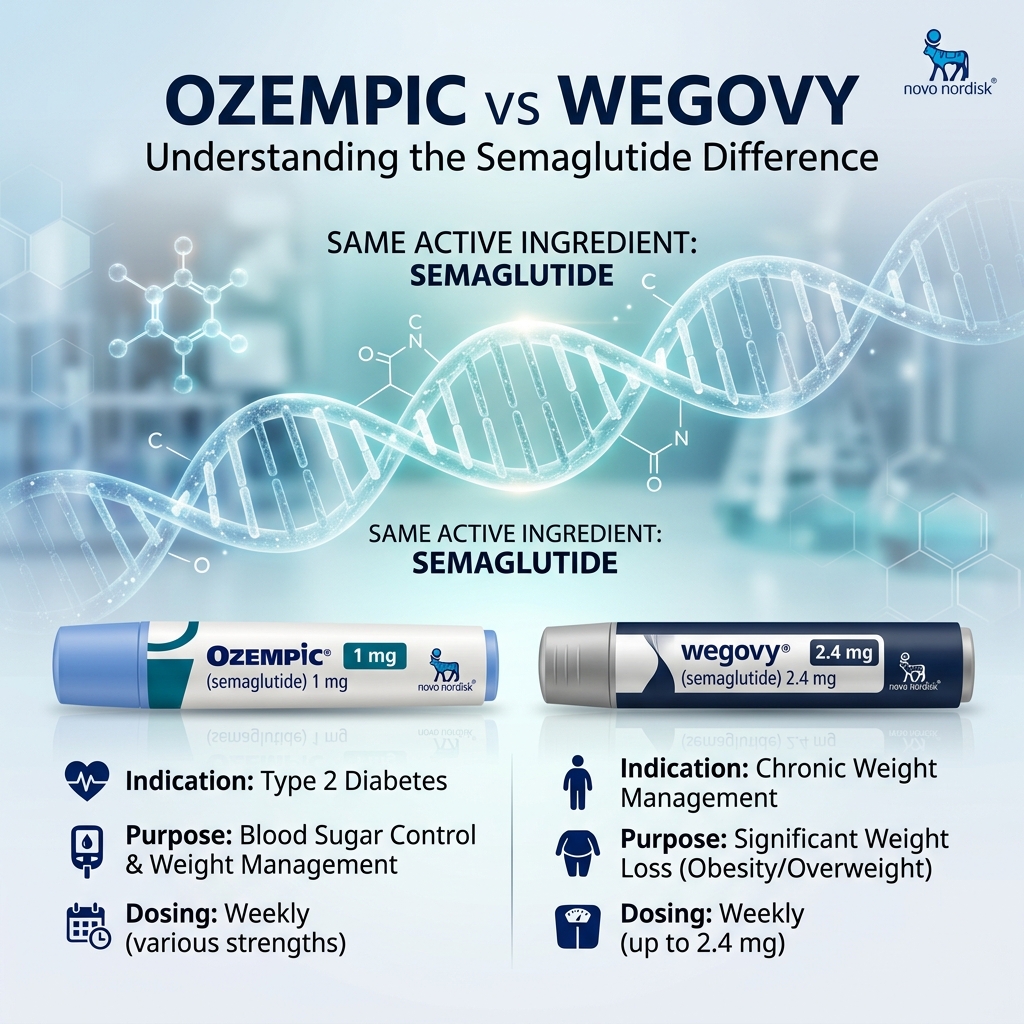
- Same active molecule: Both Ozempic and Wegovy contain semaglutide, manufactured by Novo Nordisk. The molecule in your body is identical.
- Different FDA approvals: Ozempic is approved for type 2 diabetes; Wegovy is approved for chronic weight management. This distinction drives everything from dosing to insurance coverage.
- Different maximum doses: Ozempic tops out at 2.0 mg/week. Wegovy goes to 2.4 mg/week — the dose used in the landmark weight loss trials. Wegovy wins
- Insurance is the wildcard: Ozempic is far more likely to be covered because diabetes benefits are standard. Wegovy coverage for weight loss is still inconsistent across plans.
- Affordable alternative: Compounded semaglutide through Losing Weight RX starts at $79/mo — no insurance required, same active ingredient (see our full guide to the best Ozempic alternatives for weight loss).
Why Do Two Drugs With the Same Ingredient Exist?
If you've spent any time researching GLP-1 medications, you've probably encountered this confusing reality: Ozempic and Wegovy are made by the same company (Novo Nordisk), contain the same active ingredient (semaglutide), and work through the same biological mechanism — yet they're sold as entirely different products with different price tags, different prescriptions, and wildly different insurance coverage.
This isn't an accident. It's a deliberate regulatory and commercial strategy. Understanding why it exists is the key to making a smart decision about your treatment — and potentially saving yourself more than $15,000 a year.
Here's the core distinction: the FDA doesn't approve molecules — it approves products for specific indications. Novo Nordisk submitted semaglutide twice, for two different medical conditions, resulting in two separate FDA-approved drugs with different brand names, dosing protocols, pen devices, and pricing structures.
For Type 2 Diabetes
Ozempic was the first semaglutide injectable on the market. It's FDA-approved to improve glycemic control in adults with type 2 diabetes, alongside diet and exercise. Weight loss was observed as a consistent — and welcome — side effect in diabetes trials, which led physicians to prescribe it off-label for weight management.
For Chronic Weight Management
After seeing semaglutide's weight loss effects, Novo Nordisk ran the STEP clinical trial program specifically to study semaglutide for obesity. Wegovy was the result — the same molecule, but FDA-approved specifically for chronic weight management in adults with BMI ≥30 (or ≥27 with at least one weight-related comorbidity).
The practical implication: your doctor can prescribe Ozempic off-label for weight loss, and many do. But if weight management is your primary goal, Wegovy was specifically designed, dosed, and approved for that purpose — and it reaches a higher maximum dose (2.4 mg vs. 2.0 mg) that maps directly to the clinical trial data showing ~15% average body weight loss.
How Do the Dosing Schedules Differ?
Both Ozempic and Wegovy are once-weekly subcutaneous injections. But their titration schedules — the process of gradually increasing the dose to minimize side effects — are notably different, reflecting their distinct clinical purposes.
Ozempic Titration Schedule
- Weeks 1–4: 0.25 mg once weekly (initiation dose, not therapeutic)
- Weeks 5–8: 0.5 mg once weekly (first therapeutic dose)
- Weeks 9+: 1.0 mg once weekly (standard maintenance for diabetes)
- Optional escalation: 2.0 mg once weekly (maximum dose, approved 2022 for additional glycemic control)
The 2.0 mg dose was added to Ozempic's label in 2022, but it was specifically approved for patients who needed additional glycemic control — not specifically for weight loss. When physicians prescribe Ozempic off-label for weight loss, they often aim for 1.0–2.0 mg, but they can't go beyond 2.0 mg within the product's parameters.
Wegovy Titration Schedule
- Weeks 1–4: 0.25 mg once weekly
- Weeks 5–8: 0.5 mg once weekly
- Weeks 9–12: 1.0 mg once weekly
- Weeks 13–16: 1.7 mg once weekly
- Weeks 17+: 2.4 mg once weekly (full maintenance dose)
Wegovy's five-step titration is more gradual, with two additional intermediate doses (1.7 mg and 2.4 mg) that don't exist in the Ozempic pen lineup. This is clinically significant: the 2.4 mg dose is the exact dose used in the STEP trials that demonstrated ~15% average body weight loss. You cannot reach this dose with Ozempic.
The jump from Ozempic's max of 2.0 mg to Wegovy's max of 2.4 mg represents a 20% dose increase. In the STEP 5 trial, this higher dose produced sustained 14.9% body weight loss over two years. Many patients who plateau on Ozempic's 2.0 mg would benefit from the additional 0.4 mg — but that dose simply isn't available through the Ozempic pen device.
This dosing gap is one reason physicians increasingly recommend transitioning from Ozempic to Wegovy — or to compounded semaglutide, where the dose can be titrated precisely to the provider's specification.
What Does the Clinical Trial Data Actually Show?
Both drugs have been studied extensively, but in different trial programs designed for different outcomes. Comparing them requires understanding what each trial was designed to measure.
The SUSTAIN Trials (Ozempic)
The SUSTAIN program was a series of 10+ clinical trials primarily designed to evaluate semaglutide's efficacy in type 2 diabetes management. Weight loss was a secondary endpoint in most of these studies.
- SUSTAIN 1–5: Demonstrated A1C reductions of 1.5–1.8% and average weight loss of 4.5–6.5 kg at the 1.0 mg dose over 30–56 weeks
- SUSTAIN 6: Cardiovascular outcomes trial — showed 26% reduction in major cardiovascular events (MACE) in patients with type 2 diabetes
- SUSTAIN FORTE (SUSTAIN 11): Evaluated the 2.0 mg dose. Additional A1C reduction of 0.18% over the 1.0 mg dose. Weight loss was modestly higher
The STEP Trials (Wegovy)
The STEP program was specifically designed to evaluate semaglutide at the 2.4 mg dose for chronic weight management. Weight loss was the primary endpoint.
- STEP 1: 1,961 adults without diabetes. Average weight loss: 14.9% (approximately 15.3 kg / 33.7 lbs) over 68 weeks. 86% of patients lost ≥5% body weight; 32% lost ≥20%
- STEP 2: 1,210 adults with type 2 diabetes. Average weight loss: 9.6% — lower than STEP 1, reflecting the known challenge of weight loss in diabetic populations
- STEP 3: Semaglutide + intensive behavioral therapy: 16.0% weight loss
- STEP 5: Two-year data: 14.9% sustained weight loss at 104 weeks — demonstrating durability
- STEP 8: Head-to-head with liraglutide (Saxenda): semaglutide produced 2.4× greater weight loss
The SELECT Trial (Wegovy — Cardiovascular)
In March 2024, the FDA granted Wegovy a landmark additional indication based on the SELECT trial — making it the first weight-loss medication approved to reduce cardiovascular risk. The SELECT trial enrolled 17,604 adults with established cardiovascular disease and showed:
- 20% reduction in major adverse cardiovascular events (heart attack, stroke, cardiovascular death)
- Benefits were observed regardless of starting BMI
- Cardiovascular benefit appeared independent of the degree of weight loss
This is a significant differentiator. Ozempic does not carry this cardiovascular indication for weight management, though it has cardiovascular data in its diabetes population (SUSTAIN 6). The SELECT trial specifically studied semaglutide 2.4 mg in an overweight/obese population — Wegovy's exact dose and indication.
Ozempic vs. Wegovy: Complete Feature Comparison
| Factor | Ozempic | Wegovy |
|---|---|---|
| Active Ingredient | Semaglutide | Semaglutide |
| Manufacturer | Novo Nordisk | Novo Nordisk |
| FDA Indication | Type 2 diabetes | Chronic weight management |
| Maximum Dose | 2.0 mg/week | 2.4 mg/week |
| Titration Steps | 3 steps (0.25 → 0.5 → 1.0 mg) | 5 steps (0.25 → 0.5 → 1.0 → 1.7 → 2.4 mg) |
| Time to Full Dose | ~8 weeks | ~16–17 weeks |
| Avg. Weight Loss | 14.9% (STEP 5, at 2.4 mg*) | 14.9% (STEP 1, 68 wks) |
| CV Risk Reduction | No weight-mgmt indication | 20% MACE reduction (SELECT) |
| Key Trial Program | SUSTAIN (diabetes-focused) | STEP (weight-focused) |
| Pen Device | Multi-dose pen (FlexTouch) | Single-dose prefilled pen |
| Insurance Coverage | Broad (diabetes benefit) | Limited (weight mgmt benefit) |
| Retail Cost (No Insurance) | $1,300–$1,600/mo | $1,300–$1,600/mo |
| Off-Label Weight Loss Use | Very common | N/A (on-label) |
FDA Indication
Maximum Dose
Titration Steps
Average Weight Loss
CV Risk Reduction
Insurance Coverage
Retail Cost (No Insurance)
Pen Device
*Note on weight loss data: Ozempic was not studied at 2.4 mg. The 14.9% figure often cited for "Ozempic" comes from the STEP 5 trial, which actually used Wegovy's formulation (semaglutide 2.4 mg). At Ozempic's maximum 2.0 mg dose, weight loss data is less extensively studied for the obesity indication.
Why Is Insurance Coverage So Different?
This is arguably the most important practical distinction between Ozempic and Wegovy — and the source of enormous frustration for millions of patients.
Ozempic Insurance Coverage
Because Ozempic is classified as a diabetes medication, it falls under standard pharmacy benefits that virtually all commercial insurance plans, Medicare Part D, and Medicaid programs include. If you have a type 2 diabetes diagnosis, getting Ozempic covered is relatively straightforward. Copays typically range from $25–$150/month depending on your plan tier.
The catch: if you don't have type 2 diabetes and your doctor prescribes Ozempic off-label for weight loss, insurance will almost certainly deny the claim. You'll be stuck paying $1,300–$1,600/month out of pocket.
Wegovy Insurance Coverage
Wegovy falls under weight management or anti-obesity medication (AOM) benefits — a coverage category that many insurance plans either exclude entirely or cover with significant restrictions. The landscape is improving, but slowly:
- Only about 50% of commercial insurance plans currently include AOM coverage
- Medicare Part D explicitly excludes weight loss medications by statute (with limited exceptions for the new cardiovascular indication)
- Plans that do cover Wegovy often require prior authorization, documented BMI criteria, and proof of failed lifestyle interventions
- Even when covered, Wegovy copays are often $200–$500/month due to specialty tier placement
Here's the frustrating reality: if your primary goal is weight loss and you don't have diabetes, the medication specifically FDA-approved for your situation (Wegovy) is the one least likely to be covered. Meanwhile, the diabetes medication (Ozempic) is well-covered — but prescribed off-label for a use it wasn't approved for.
This is a major reason why compounded semaglutide has exploded in popularity. At $79/month through Losing Weight RX, it bypasses the insurance maze entirely while providing the same active molecule at provider-customized doses.
What About the Pen Devices — Are They Interchangeable?
No. Despite containing the same molecule, Ozempic and Wegovy use completely different injection pen devices that are not interchangeable.
The Ozempic Pen
Ozempic uses Novo Nordisk's FlexTouch multi-dose pen. Each pen contains multiple doses and features a dial that lets you select the precise dose. Two pen strengths are available: one for the 0.25/0.5 mg doses and another for the 1.0/2.0 mg doses. Patients use needles that attach to the pen tip and are disposed of after each injection.
The Wegovy Pen
Wegovy uses a single-dose prefilled pen — a different design from the Ozempic FlexTouch. Each pen contains exactly one dose, and there are five separate pen products corresponding to each titration dose (0.25, 0.5, 1.0, 1.7, and 2.4 mg). There's no dial to adjust; you simply inject the entire contents.
The key practical difference: the Ozempic pen offers dose flexibility (you can dial in your dose), while the Wegovy pen is simpler to use but locked to a fixed dose. For patients who need precise dose adjustments between standard increments, compounded semaglutide offers the most flexibility — your provider can prescribe exactly the dose your body needs, drawn from a vial with a standard insulin syringe.
Can You Switch Between Ozempic and Wegovy?
Yes — and it's quite common. Since both contain the same active molecule, switching is medically straightforward. No washout period is required. Here are the most common switching scenarios:
Ozempic → Wegovy
This is the most frequent switch. Patients who were prescribed Ozempic off-label for weight loss may transition to Wegovy to access the higher 2.4 mg dose and the official weight management indication. Your provider will map your current Ozempic dose to the equivalent Wegovy step and continue titration from there.
Wegovy → Ozempic
Less common, but it happens — particularly when insurance coverage changes. Some patients who lose Wegovy coverage but have a type 2 diabetes diagnosis may switch to Ozempic to access better insurance benefits. The trade-off is the lower maximum dose (2.0 mg vs. 2.4 mg).
Either → Compounded Semaglutide
Increasingly, patients on either brand-name product are switching to compounded semaglutide for cost reasons. The active molecule is identical, and compounded formulations can be dosed at any increment — including Wegovy's 2.4 mg target dose — at a fraction of the cost.
Same Semaglutide. $79/Month. No Insurance Required.
Why pay $1,300+ for Ozempic or Wegovy when compounded semaglutide delivers the same active ingredient? Complete a 5-minute assessment and a licensed provider will customize your dose.
Start Your AssessmentHow Does Cost Really Compare?
Let's cut through the complexity with actual numbers. Here's what you'll realistically pay depending on your situation:
Losing Weight RX
- Same active semaglutide molecule
- No insurance required
- Custom dosing (any increment)
- FSA/HSA accepted
- Free expedited shipping
- No contracts, cancel anytime
Ozempic / Wegovy
- FDA-approved brand product
- Prefilled pen device
- Insurance may cover (varies)
- Fixed dose increments only
- Manufacturer savings card available
- Subject to shortages
To put this in perspective: a patient paying out-of-pocket for brand-name Ozempic or Wegovy will spend $13,848–$17,448 more per year than a Losing Weight RX patient getting the same active molecule. Over two years of treatment (the duration of the STEP 5 trial), that's a potential savings of $27,696–$34,896.
What About Side Effects — Are They the Same?
Because Ozempic and Wegovy contain the identical molecule, their side effect profiles are essentially identical. The same GLP-1 receptor is being activated, producing the same physiological effects — and the same potential side effects.
Most Common Side Effects (Both Drugs)
- Nausea: ~44% (most common during titration, typically resolves within 4–8 weeks)
- Diarrhea: ~30%
- Vomiting: ~24%
- Constipation: ~24%
- Abdominal pain: ~20%
- Headache: ~14%
- Injection site reactions: Mild redness, rare
Dose-Dependent Considerations
Since Wegovy's maximum dose (2.4 mg) is 20% higher than Ozempic's maximum (2.0 mg), patients on Wegovy's full maintenance dose may experience slightly more pronounced side effects at steady state. However, Wegovy's more gradual five-step titration schedule is designed to offset this by giving the body more time to adjust. Most clinical comparisons show no statistically significant difference in side effect severity between the two products at equivalent doses.
Both medications carry the same boxed warning regarding the risk of thyroid C-cell tumors (including medullary thyroid carcinoma). Neither should be used by patients with a personal or family history of MTC or Multiple Endocrine Neoplasia syndrome type 2 (MEN 2).
Is Compounded Semaglutide a Good Alternative to Both?
For millions of patients who can't access or afford brand-name Ozempic or Wegovy, compounded semaglutide has become the practical solution. Here's what you need to know:
- Same active molecule: Compounded semaglutide contains the identical active pharmaceutical ingredient as both Ozempic and Wegovy
- Legally authorized: Compounding is permitted under federal 503A/503B regulations during active drug shortages — and semaglutide has been on the FDA shortage list
- Not individually FDA-approved: Compounded preparations have not undergone the FDA's new drug approval process for safety, efficacy, or manufacturing quality. They are custom preparations from licensed pharmacies
- Custom dosing: Unlike the fixed-dose Ozempic and Wegovy pens, compounded semaglutide can be dosed at any increment — giving providers maximum flexibility to optimize your response
- Dramatically lower cost: Through Losing Weight RX, compounded semaglutide is $79/month flat — roughly 90% less than brand-name retail pricing
Through Losing Weight RX, the process is straightforward: complete a 5-minute online medical assessment, receive a provider evaluation within 24 hours, and — if approved — have your compounded semaglutide shipped directly to your door with free expedited delivery. No membership fees, no contracts, and FSA/HSA cards are accepted. The program is available in all 50 states.
For a deeper dive on compounded versus brand-name options, read our complete guide to semaglutide or our analysis of the cheapest semaglutide options in 2026.
Which Should You Choose — Ozempic, Wegovy, or Compounded?
There's no single right answer. The best choice depends on your diagnosis, insurance situation, and budget. Here's a decision framework:
Choose Ozempic If:
- You have a confirmed type 2 diabetes diagnosis and your insurance covers it
- Your primary goal is glycemic control with weight loss as a secondary benefit
- Your plan covers Ozempic at a reasonable copay ($25–$150/month)
- You're comfortable with a maximum dose of 2.0 mg
Choose Wegovy If:
- Your primary goal is chronic weight management (not diabetes control)
- Your insurance covers Wegovy, or you can access it through a manufacturer savings card
- You want access to the 2.4 mg dose — the exact dose validated in the STEP trials
- You have established cardiovascular disease and want the SELECT trial's proven 20% MACE reduction
- You want the medication that's FDA-approved for your specific indication
Choose Compounded Semaglutide (Losing Weight RX) If:
- You don't have insurance coverage for either brand-name product
- You're paying out-of-pocket and need the most affordable option — $79/month vs. $1,300+
- You want custom dosing flexibility that brand-name pens can't provide
- You want a no-contract, no-membership, transparent pricing structure
- You're currently on Ozempic or Wegovy and want to reduce your monthly cost without changing medications
- You're in a state or situation where brand-name supply is subject to shortages
Frequently Asked Questions
Yes and no. Both contain the same active ingredient — semaglutide — manufactured by Novo Nordisk. However, they are different FDA-approved products with different indications: Ozempic is approved for type 2 diabetes management, while Wegovy is approved for chronic weight management. They also use different injection pen devices and have different maximum doses (2.0 mg for Ozempic vs. 2.4 mg for Wegovy).
Physicians can prescribe Ozempic off-label for weight loss, which is legal and common practice. However, insurance typically will not cover Ozempic for weight loss in patients without type 2 diabetes. Many patients in this situation turn to compounded semaglutide through telehealth platforms like Losing Weight RX, which provides the same active molecule at $79/month with no insurance needed.
Ozempic is classified as a diabetes medication, which falls under standard pharmacy benefits that virtually all insurance plans include. Wegovy is classified as a weight management medication — a category that many plans exclude or restrict. Only about 50% of commercial plans currently cover anti-obesity medications, and Medicare Part D explicitly excludes weight loss drugs by statute.
Yes. Since both contain semaglutide, switching is straightforward under provider guidance. No washout period is needed. Your provider will map your current dose to the equivalent on the other product and adjust the titration schedule accordingly. The most common reasons for switching are insurance coverage changes and a desire to reach Wegovy's higher 2.4 mg maintenance dose.
Compounded semaglutide contains the same active molecule as Ozempic and Wegovy but is custom-prepared by state-licensed U.S. compounding pharmacies under federal 503A/503B regulations. It is not individually FDA-approved, meaning the FDA has not evaluated these specific preparations for safety, efficacy, or manufacturing quality. However, it is legally authorized during active drug shortages and prescribed by licensed providers after a medical evaluation.
Compounded semaglutide through Losing Weight RX costs $79 per month flat — no membership fees, no hidden charges, no contracts. This compares to $1,300–$1,600 per month for brand-name Ozempic or Wegovy without insurance. FSA and HSA cards are accepted, and free expedited shipping is included with every order. The program is available in all 50 states.
Get Semaglutide for $79/Month — No Insurance Needed
Stop overpaying for brand-name Ozempic or Wegovy. Complete your 5-minute assessment and a licensed U.S. provider will prescribe compounded semaglutide shipped directly to your door.
Start Your AssessmentClinical References & Sources
- Wilding, J. P. H., Batterham, R. L., et al. (2021). Once-weekly semaglutide in adults with overweight or obesity (STEP 1). New England Journal of Medicine, 384(11), 989-1002. ClinicalTrials.gov (NCT03548935)
- Davies, M., Færch, L., et al. (2021). Semaglutide 2.4 mg once a week in adults with overweight or obesity, and type 2 diabetes (STEP 2). The Lancet, 397(10278), 971-984. ClinicalTrials.gov (NCT03552757)
- Garvey, W. T., Batterham, R. L., et al. (2022). Two-year effects of semaglutide in adults with overweight or obesity (STEP 5). Nature Medicine, 28, 2083-2091. ClinicalTrials.gov (NCT03693430)
- Lincoff, A. M., Brown-Frandsen, K., et al. (2023). Semaglutide and cardiovascular outcomes in obesity without diabetes (SELECT). New England Journal of Medicine, 389(24), 2221-2232. ClinicalTrials.gov (NCT03574597)
- Marso, S. P., Bain, S. C., et al. (2016). Semaglutide and cardiovascular outcomes in patients with type 2 diabetes (SUSTAIN 6). New England Journal of Medicine, 375(19), 1834-1844. ClinicalTrials.gov (NCT01720446)
- U.S. Food and Drug Administration. (2024). Human Drug Compounding Under Section 503A of the FD&C Act. FDA.gov Guidance